

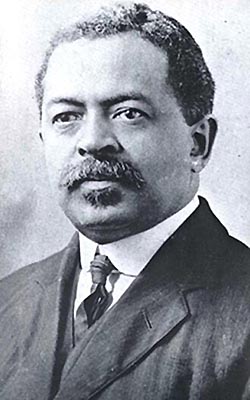
Monroe Trotter


April 7 …
William Monroe Trotter was a trailblazing journalist, publisher, and civil rights activist whose work left an enduring mark on both American journalism and the fight for racial equality.
Born on this day in 1872 in Ohio and raised in Massachusetts, Trotter emerged during a time when the promise of Reconstruction had given way to the harsh realities of segregation and systemic discrimination. A brilliant scholar, he graduated magna cum laude from Harvard University in 1895, becoming one of the first African Americans to earn a Phi Beta Kappa key there. Though he encountered racial barriers in the business world, he redirected his talents into the press, recognizing the power of media to uplift, inform, and mobilize the Black community.
In 1901, Trotter founded the Boston Guardian, a weekly newspaper dedicated to advocating for civil rights and challenging the racial injustices of his time. Unlike many papers that catered to more moderate views, Trotter’s Guardian was unflinching in its stance. The paper boldly confronted segregation, racial violence, and the complacency of both white liberals and some African American leaders. Trotter used his publication to fiercely criticize Booker T. Washington and his accommodationist philosophy, arguing instead for full political and social equality — without compromise.
What set Trotter apart as a newspaperman was not just his editorial voice, but his savvy in running an independent publication in a hostile environment. Trotter built a business model that relied on grassroots support rather than mainstream advertisers who typically avoided Black publications.
Trotter kept printing costs low and distributed the paper directly within communities, often selling or delivering it himself. This direct-to-reader approach made the Boston Guardian financially sustainable and deeply connected to its audience, a model that would later inspire other independent Black newspapers.
Trotter also understood the importance of local relevance and national scope. He filled the Guardian with a mix of local community stories and hard-hitting national political commentary, creating a publication that was both informative and empowering. His newspaper served as a rallying point for activism and discussion in Black communities throughout the North. In an era when Black voices were often silenced or distorted in mainstream media, the Guardian gave people a space to see their realities reflected and their concerns validated.
Beyond journalism, Trotter played a pivotal role in early civil rights organizing. In 1905, he co-founded the Niagara Movement alongside W.E.B. Du Bois, which laid the intellectual and strategic foundation for the NAACP. The movement rejected the slow, conciliatory approach to civil rights and instead demanded full equality in education, voting rights, and employment. Trotter’s emphasis on agitation, protest, and political pressure would become cornerstones of the civil rights movement decades later.
One of the most dramatic moments of Trotter’s activism occurred in 1914, when he confronted President Woodrow Wilson over the segregation of federal offices. During a meeting at the White House, Trotter challenged Wilson directly, refusing to accept the president’s justification for discriminatory policies. The confrontation became national news and, although it cost Trotter political capital, it highlighted his courage and refusal to be silenced in the face of injustice.
The contributions of Monroe Trotter to American history lie not only in his journalism but in his relentless advocacy for civil rights and racial equality. He demonstrated how independent Black media could serve as both a business and a battleground for justice. His legacy lives on in the voices of journalists, activists, and everyday citizens who refuse to accept injustice as inevitable. Trotter used the power of the press not just to inform—but to transform — a nation still grappling with its promise of equality for all.
