
September 16 …
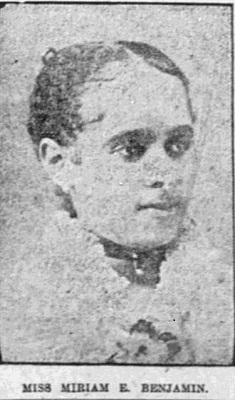
Miriam Elizabeth Benjamin was a pioneering American inventor, educator, and civic leader whose life and work embodied the intellectual ambition and social progress of Black America in the late 19th and early 20th centuries.
Best known for her patented “Gong and Signal Chair,” Benjamin stands as one of the first African American women to receive a United States patent. Her accomplishments resonate throughout the intertwined histories of innovation, education, and civil rights. With her inventive spirit and dedication to public service, Benjamin not only advanced technology but also contributed to the broader cultural and political transformation of the United States.
Born on September 16, 1861 in 1861 in Charleston, SC, Benjamin was raised in a family that prioritized education, civic duty, and resilience during the turbulent Reconstruction era. The family later relocated to Boston, where she took advantage of the city’s reform-minded educational opportunities. She furthered her studies at Howard University in Washington, DC, an institution established to educate formerly enslaved individuals and their descendants.
At Howard, Benjamin trained as a teacher, embracing the belief held by many Black intellectuals of her time that education was both a personal mission and a collective strategy for racial uplift. Her academic background connected her to a network of Black professionals who viewed learning, invention, and leadership as interrelated pursuits.
Benjamin secured a patent from what is now the United States Patent and Trademark Office for her Gong and Signal Chair, a device designed to enable seated individuals to signal attendants without leaving their seats. Her application for Patent No. 386,289 — granted on July 17, 1888 — stated that her chair would “reduce the expenses of hotels by decreasing the number of waiters and attendants, to add to the convenience and comfort of guests and to obviate the necessity of hand clapping or calling aloud to obtain the services of pages.”
This invention aimed to enhance efficiency and decorum in large venues and was even recommended for use in the U.S. House of Representatives, showcasing the practical implications of her design. It was also a precursor to the signaling system used on airplanes for passengers to seek assistance from flight attendants.
Benjamin’s endeavors paralleled those of other prominent African American innovators. She is the second African-American woman to be granted a United States patent, after Judy W. Reed. Other early American contemporaries to her were Sarah Boone, Ellen Eglin, and Sarah Goode, who also secured patents during a time of stark inequality. By becoming a patent holder, Benjamin became part of this small, yet growing group of Black inventors whose creativity challenged stereotypes about race, gender, and intellectual ability.
She was a contemporary of other notable inventors like Alexander Graham Bell and Granville T. Woods, whose collective efforts helped shape the technological landscape of the Gilded Age. Her achievement was groundbreaking, occurring at a time when both women and African Americans faced significant barriers to patenting and professional recognition.
Writing under the pseudonym E.B. Miriam, Benjamin also created musical compositions for piano and band. One of her pieces was featured in Theodore Roosevelt’s presidential campaign in 1904.
Although records of direct mentorship are scarce, Benjamin was undoubtedly influenced by the intellectual atmosphere cultivated by Black educational institutions and reform movements that promoted self-determination and excellence. As a teacher and public servant, she inspired younger generations of students and professionals, demonstrating how creativity and civic engagement can coexist in a life rich with purpose.
In addition to her patent, Benjamin dedicated herself to public service, including a role as a clerk in the federal government, thereby increasing the representation of educated Black women in national institutions. While she did not receive the formal accolades that later inventors might attain, her patent was a rare and significant recognition of her originality and technical prowess.
Today, Benjamin’s legacy remains a vital part of the broader narrative of American innovation, embodying both a pioneering spirit for women inventors and a testament to the intellectual contributions of African Americans to the nation’s social and cultural fabric.
Through her achievements in invention and education, Miriam Elizabeth Benjamin helped pave the way for a more inclusive vision of American progress.