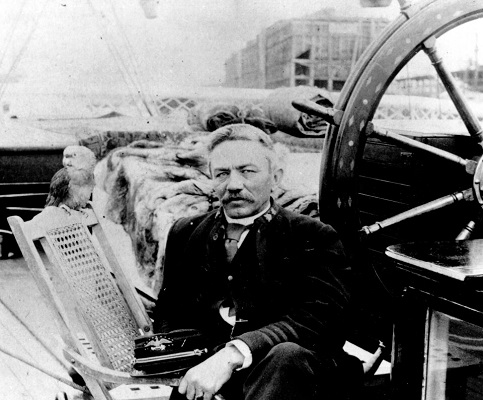
Michael Augustine Healy
September 22 …
Michael Augustine Healy was a pioneering figure in American maritime history and the first man of African descent to command a U.S. government ship.
He was a member of the African-American and Irish-American Healy family, notable for the high achievements of its first generation of children, who were born into slavery in the second half of the 19th century.
Born on September 22, 1839 in Jones County, GA near Macon to an Irish immigrant father and an enslaved African American mother, Michael Healy and his siblings were legally considered enslaved despite their father’s wealth and status. His siblings were:
- James Augustine Healy — first known African American Catholic priest and bishop in the United States;
- Patrick Francis Healy — first African American Jesuit and university president (the 29th president of Georgetown University); and
- Mary Magdalen Healy — first African American superior of a religious community in the United States.
Like his brothers, Healy was sent North for his education and to escape the racial constraints of the South. He, however, was restless and adventurous by nature, and rather than pursue formal studies, he joined the merchant marine as a teenager, launching a career that would take him to the farthest reaches of American territory.
In 1865, Healy was commissioned as a third lieutenant in the United States Revenue Cutter Service, the forerunner to the U.S. Coast Guard. At a time when the American frontier was expanding into the Alaskan territories, Healy became one of the most experienced and respected officers in the Arctic region.
Healy served aboard several vessels, but was most famously associated with the USRC Bear, a ship he commanded for many years. He became a vital figure in asserting U.S. presence and authority in the remote and often lawless waters off Alaska, enforcing federal law, rescuing shipwrecked sailors, delivering supplies, and providing medical aid to isolated Native communities.
Captain Healy’s contributions extended beyond military enforcement. He worked to protect Indigenous populations from exploitation by traders and whalers, supported efforts to introduce reindeer herding as a sustainable food source for Alaskan Natives, and promoted cross-cultural cooperation in one of the harshest environments on Earth.
His work blended humanitarian concern with the responsibilities of federal authority, and he earned the respect of both his crew and many local communities for his fairness, courage, and leadership. Despite operating in an era of deep racial prejudice, Healy’s commanding presence and competence allowed him to rise through the ranks and maintain authority in one of the most challenging assignments in the service.
Throughout his career, Healy’s racial background was not widely known or publicly acknowledged, allowing him to serve in a position that would have been nearly impossible for an openly Black man in the 19th-century military. However, this reality also meant that his story was largely excluded from mainstream historical narratives until long after his death. It is only in recent decades that historians have fully recognized the significance of his achievements, particularly as they relate to the broader history of African Americans in federal service and the complexities of racial identity in America.
Healy’s legacy is that of a trailblazer who helped shape the reach and responsibilities of the United States in its northernmost territories. As a ship captain, lawman, humanitarian, and federal officer, he embodied a form of leadership grounded in action, resilience, and moral conviction. His life challenges the boundaries of how we define American history and who we recognize as its agents.
Today, Michael Augustine Healy is honored as a foundational figure in the history of the U.S. Coast Guard and a symbol of the hidden yet essential contributions of African Americans to the expansion and governance of the American frontier.