

August 8 …
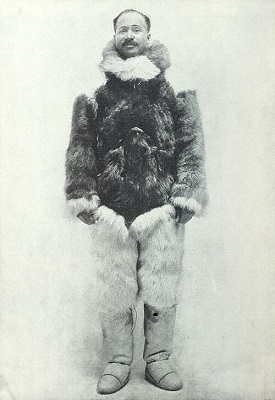
Matthew Henson was an Arctic explorer whose skill, leadership, and deep knowledge of Inuit survival techniques made him indispensable to early American polar exploration and whose later recognition reshaped how U.S. exploration history acknowledges Black contributions.
Born August 8, 1866 in Charles County, MD, Henson’s early life was defined by poverty, loss of family, and limited formal education at the N Street School in Washington, DC. As a teenager, he went to sea as a cabin boy, where he acquired skills in seamanship, carpentry, and basic literacy under the guidance of ship captains and mentors aboard merchant vessels. This hands-on education and worldly experience equipped him for his future polar expeditions.
Henson’s significant achievements stem from his 18-year partnership with Commander Robert E. Peary, commencing with Greenland voyages in the 1890s and culminating in the 1908–1909 expedition, during which Peary claimed to have reached the geographic North Pole. Henson not only learned Inuit languages and techniques, but also constructed and maintained sledges, trained teams in dogsled handling, and often led the final sledge parties. Contemporaries noted he likely arrived at the pole ahead of Peary.
Throughout their endeavors, Henson collaborated with Inuit companions, including Ootah, Egingwah, Seegloo, and Ooqueah, as well as expedition colleagues like Donald B. MacMillan. His memoir, A Negro Explorer at the North Pole (1912), and the subsequent biography, Dark Companion (co-authored with Bradley Robinson, 1947), detail these contributions.
Henson drew inspiration and guidance from sea captains during his merchant-marine years and from Robert Peary, who depended on him as the “first man” on Arctic journeys. His contemporaries in polar exploration included Peary, Donald MacMillan, and other early 20th-century explorers, with the contrast between Peary’s fame and Henson’s marginalization being quite pronounced.
Henson trained other expedition members in Arctic travel and profoundly influenced the many Americans and Inuit who worked alongside him. He respected the resilience and knowledge of the Inuit people and acknowledged leaders in exploration, like Peary, as mentors despite the racial inequities in recognition.
Henson received limited recognition during his lifetime, but this changed in later years and posthumously. He gained honorary membership in the Explorers Club, and received a duplicate Peary Polar Expedition Medal awarded by Congress in 1944 — along with other acknowledgments during the 1940s and 1950s.
In 1955, Henson received honorary degrees from Howard University and Morgan State College. And, in 1954, he received a presidential citation from Dwight D. Eisenhower. Public honors from Presidents Truman and Eisenhower followed suit.
Henson is believed to be a great-great-granduncle of actress Taraji P. Henson.
Matthew Henson died on March 9, 1955, at the age of 88, in the Bronx, NY and was buried at Woodlawn Cemetery. In 1988, he and his wife Lucy were reinterred with full military honors at Arlington National Cemetery, rectifying the historical oversight of his contributions.