Mary Jackson

April 9 …
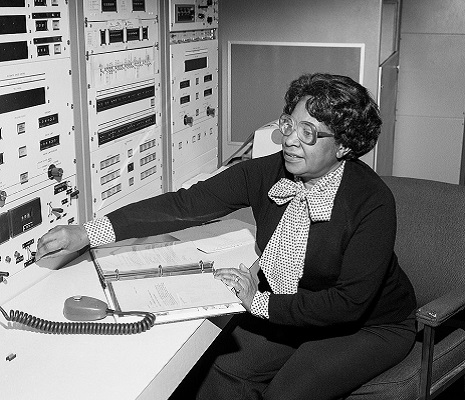
Mary Jackson was a pioneering mathematician and aerospace engineer whose remarkable career at NASA helped break both scientific and social barriers.
Born in on this day in 1921 in Hampton, VA, Jackson graduated from Hampton Institute with degrees in mathematics and physical science. Her early career involved teaching math and working as a bookkeeper, but her life took a pivotal turn when she joined the National Advisory Committee for Aeronautics (NACA), which later became NASA, in 1951. She began as a research mathematician, or “human computer,” at Langley Research Center, where her calculations were vital to aerodynamic studies.
As one of the few Black women employed in such a technical capacity at the time, Jackson faced systemic racial and gender discrimination. Segregation was still entrenched in Virginia, and she had to navigate separate work facilities and restrooms.
Nonetheless, Jackson persisted and excelled. Her aptitude and determination led her to work under engineer Kazimierz Czarnecki, who encouraged her to enter a training program that would allow her to become an engineer — a move that required Jackson to petition the city of Hampton to attend segregated classes at a white high school.
Jackson became NASA’s first Black female engineer in 1958. Her work focused on the behavior of air around aircraft and spacecraft, contributing directly to the design and safety of high-speed flight.
Jackson co-authored numerous research reports, delving into complex topics such as boundary layer behavior and wind tunnel experiments. Her insights played a key role in advancing the U.S. space program during a time of intense competition with the Soviet Union.
In addition to her technical contributions, Jackson was a tireless advocate for equal opportunity within NASA. After decades in engineering, she made a bold choice to shift to human resources so she could more effectively promote the hiring and advancement of women and minorities.
Jackson worked to remove barriers that prevented others from achieving the success she had earned through hard work and perseverance. Her advocacy helped shape NASA’s culture into a more inclusive and diverse environment.
Jackson’s legacy was brought to public attention through the 2016 film Hidden Figures, in which she was portrayed by actress Janelle Monáe. The film, based on the book, Hidden Figures: The American Dream And The Untold Story Of The Black Women Who Helped Win The Space Race by Margot Lee Shetterly, shed light on the crucial yet often overlooked contributions of Jackson and her colleagues — Katherine Johnson, Dorothy Vaughan, Christine Darden, and many others. Their behind-the-scenes work was instrumental in sending the first Americans into space, underscoring the fact that the space race was not just won in rockets and engines, but also in minds like Jackson’s.

The Mary W. Jackson NASA Headquarters sign and NASA logo insignia in Washington, D.C.
In 2020, NASA honored her legacy by renaming its Washington, D.C. headquarters the Mary W. Jackson NASA Headquarters. Her story continues to inspire new generations of scientists, engineers, and activists.
Through her brilliance, resilience, and commitment to justice, Mary Jackson not only helped America reach the stars but also paved the way for others to follow in her trailblazing footsteps.