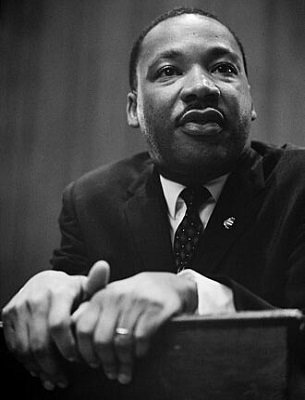
Martin Luther King Jr.


January 15 …
Rev. Dr. Martin Luther King Jr. was a transformative figure in American history whose leadership during the civil rights movement redefined the nation’s understanding of justice, equality, and nonviolent protest.
Born on January 15, 1929 in Atlanta, GA, King was raised in a family of faith and activism. The son of a Baptist minister, he was steeped in the values of service, community, and moral responsibility. A gifted student, King earned a doctorate in theology and was deeply influenced by both Christian teachings and the nonviolent philosophy of Mahatma Gandhi — principles that would become the foundation of his life’s work.
King rose to national prominence in 1955 when he led the Montgomery Bus Boycott, a 381-day protest sparked by Rosa Parks’ arrest for refusing to give up her seat to a white passenger. As the boycott’s spokesperson and leader, King displayed extraordinary courage and eloquence, articulating a vision of equality grounded in love and justice. The boycott ended in a Supreme Court decision desegregating public buses and marked the beginning of King’s enduring role as the moral voice of the civil rights movement.
As the president of the Southern Christian Leadership Conference (SCLC), King coordinated a series of nonviolent campaigns across the South aimed at dismantling Jim Crow laws and securing voting rights, fair employment, and desegregation. His efforts in cities like Birmingham, Selma, and Albany brought national and international attention to the brutal realities of racism in America. The 1963 Birmingham campaign, in particular, exposed the violent response of white authorities to peaceful protests and galvanized public opinion. King’s strategy of peaceful resistance forced the country to confront the hypocrisy of its democratic ideals.
In August 1963, King delivered his iconic “I Have a Dream” speech during the “March on Washington for Jobs and Freedom.” Standing before the Lincoln Memorial and addressing over 250,000 people, King called for an America where individuals would be judged not by the color of their skin but by the content of their character. The speech became one of the most defining moments in American history, capturing the hopes of a generation and becoming a universal declaration of human dignity and civil rights.
King’s impact extended beyond race relations; he also addressed issues of poverty, war, and economic justice. In 1967, he publicly opposed the Vietnam War, arguing that the fight for civil rights was inseparable from a broader struggle against militarism and economic exploitation. His final campaign, the Poor People’s Campaign, sought to unite Americans across racial lines in demanding fair housing, employment, and healthcare — further proving his commitment to justice in its fullest sense.
Tragically, King was assassinated on April 4, 1968, in Memphis, TN, where he had traveled to support the workers participating in the Memphis Sanitation Strike. His death sent shock waves through the nation and the world, prompting both grief and renewed determination to fulfill the vision he had championed. Yet his ideas and influence did not die with him — they became more deeply embedded in the American conscience and global movements for social change.
King’s legacy is preserved in countless ways: in legislation like the Civil Rights Act of 1964 and the Voting Rights Act of 1965, both of which he helped inspire and influence; in institutions that bear his name; and in the annual observance of MLK Day — a national holiday established in 1983 to honor his life and contributions. His speeches, sermons, and writings continue to serve as moral compasses, offering clarity in times of division and inspiration in times of struggle.
More than a civil rights leader, Martin Luther King Jr. was a visionary who dared to imagine a better America — and worked tirelessly to bring it closer to reality. His insistence on nonviolence as a means of transformation, his unwavering moral clarity, and his belief in the power of love and justice have etched him into the heart of American culture and history. His life reminds the world that change is possible when conscience, courage, and compassion converge.
* Photo of Rev. Dr. Martin Luther King Jr. at a press conference in March 1964 by Marion S. Trikosko