

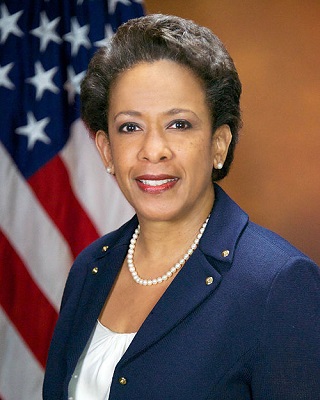
Loretta Lynch

May 21 …
Loretta Lynch is a distinguished attorney whose career in public service culminated in her historic tenure as the first African American woman to serve as Attorney General of the United States, a role in which she helped shape modern conversations about justice, civil rights, and the rule of law.
Born on May 21, 1959 in Greensboro, NC and raised in a family deeply committed to faith and community leadership, Lynch cultivated an early appreciation for fairness and civic responsibility. Her journey from Harvard Law School to leading the nation’s highest law enforcement office exemplifies a career marked by rigor, discretion, and unwavering dedication to institutional integrity.
Lynch first rose to national prominence as the U.S. Attorney for the Eastern District of New York, a role she held twice under Presidents Bill Clinton and Barack Obama. In this capacity, she managed high-profile prosecutions involving terrorism, public corruption, civil rights violations, and financial crimes. Her office achieved significant convictions in cases related to international terrorism plots and police brutality, solidifying her reputation as a meticulous and impartial prosecutor.
Colleagues frequently praised her calm and methodical leadership style, earning her respect across political divides. Throughout her federal career, she collaborated with contemporaries like Eric Holder, whom she succeeded as Attorney General, and other senior Justice Department officials as they navigated complex challenges in national security and civil rights.
Nominated by Barack Obama in 2014 and confirmed in 2015, Lynch took the helm of the Department of Justice during a period marked by heightened national tension surrounding policing, voting rights, cybersecurity, and public trust in institutions. As Attorney General, she focused on strengthening relationships between law enforcement and communities, defending voting access, and combating violent extremism.
Additionally, she tackled issues of corporate accountability and data security, emphasizing the Department’s evolving role in the digital age. Her tenure required balancing independence with executive responsibility, especially during politically sensitive investigations that tested public confidence in federal law enforcement.
Lynch has credited her parents, especially her father, a Baptist minister, as key influences in shaping her moral compass and sense of service. Professionally, she drew inspiration from generations of civil rights lawyers who wielded the law as an instrument for change, reflecting the broader legacy of the civil rights movement.
Throughout her career, she has worked alongside peers who expanded representation in federal leadership, signaling a gradual diversification of the American legal establishment. Her ascent to the nation’s top legal office symbolizes not only personal achievement but also broader social progress, resonating deeply with young attorneys and aspiring public servants.
Over her career, Lynch has received numerous accolades recognizing her legal expertise and public service, including awards from bar associations and civic organizations for her leadership and commitment to justice. Her historic confirmation as Attorney General marked a significant milestone in American history, underscoring the evolving inclusivity of federal leadership.
After leaving office, she returned to private practice and public speaking, continuing to engage in discussions about governance, accountability, and the preservation of democratic ideals.
The legacy of Loretta Lynch lies not only in the cases she prosecuted or the policies she advanced but also in the example she set as a principled and measured steward of the law during a pivotal moment in American history.
