
November …
The Lafayette Theatre in Harlem, NY was one of the most influential cultural institutions of the early 20th century, shaping American theater, music, and social progress, while helping to redefine Black artistic expression and public life.
Opened in November 1912 at 132nd Street and Seventh Avenue, the theater was established by banker Meyer Jarmulowsky and designed by architect Victor Hugo Koehler, boasting a grand capacity of 1,500 seats and often referred to as “the House Beautiful.” From its inception, the theater set itself apart with a pioneering social mission.
In 1913, it became one of the first major theaters in New York City to desegregate its seating, allowing Black patrons access to orchestra-level seats instead of relegating them to balconies. This landmark decision was a notable advancement in the American social justice movement, positioning the Lafayette as both an artistic and political hub.
The resident company, the Lafayette Players — founded by Anita Bush in 1915 — showcased a diverse repertoire of classical and contemporary works primarily for Black audiences. They nurtured a new, engaged urban readership during the early cultural renaissance of Harlem.
The theater’s impact on American entertainment and music was significant, particularly during the Harlem Renaissance. Early productions like “Darktown Follies” in 1913 introduced groundbreaking dance styles such as the Texas Tommy, paving the way for the development of Black musical theater and attracting both Black and white audiences to the uptown scene, thus influencing Broadway trends.
The Lafayette also played a crucial role in jazz history, featuring legendary artists like Duke Ellington, Fletcher Henderson, and Chick Webb. It served as a springboard for emerging sounds and collaborations that would shape American music. Its programming blended theater and music, fostering innovation, while promoting Black performers at a time when mainstream venues frequently excluded them, thereby transforming the cultural landscape of the United States.
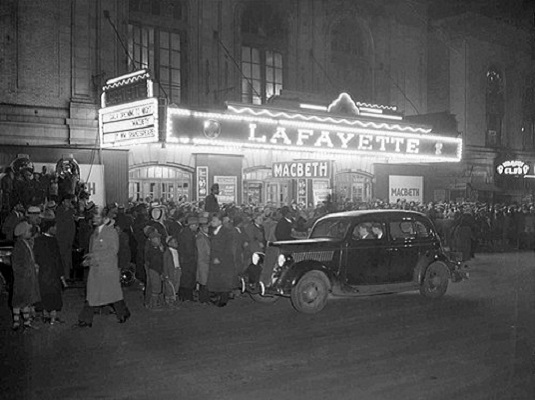
The Lafayette achieved national recognition in 1936 with the Federal Theatre Project’s production of Macbeth, directed by Orson Welles — famously dubbed the “Voodoo Macbeth” because featured an all-Black cast. This production, backed by the Works Progress Administration, garnered acclaim for its artistic boldness and cultural significance. It symbolized the potential of publicly funded art and the elevation of Black theatrical excellence on a national stage.
Although the original theater closed its doors in 1951 and was eventually demolished in 2013, its legacy endured through institutions like the New Lafayette, founded by Robert Macbeth in 1967. The new theater continued the original’s mission of representing Black life and furthering socially conscious drama within the Black Arts Movement.
Collectively, the Lafayette Theatre garnered lasting recognition not merely through formal accolades, but also through its enduring impact on American culture, the advancement of civil rights, and the evolution of theater and music as powerful tools for social change.