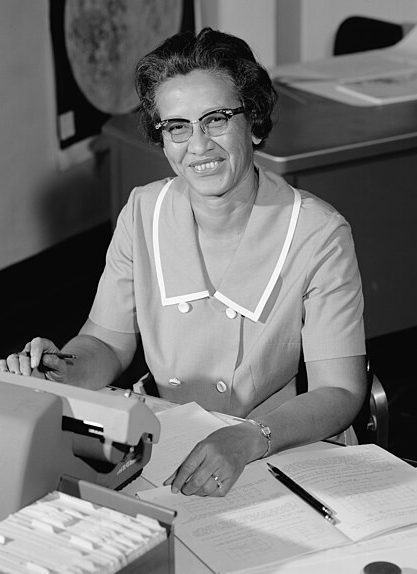
Katherine Johnson

August 26
Creola Katherine Johnson was a brilliant mathematician and physicist whose calculations were critical to the success of the United States’ space program during its most formative years.
Born on August 26, 1918, in White Sulphur Springs, WV, Johnson exhibited extraordinary mathematical talent from a young age. She attended West Virginia State College, graduating summa cum laude at just 18 with degrees in mathematics and French. Her keen analytical skills and relentless curiosity set her on a path that would eventually change the course of American space exploration.
Johnson’s computations have influenced every major space program from Mercury through the Shuttle program. Johnson was hired as a research mathematician at the Langley Research Center with the National Advisory Committee for Aeronautics (NACA) after they opened hiring to African-Americans and women.
In 1953, Johnson began working at NACA, which would later become NASA. She joined a pool of Black women mathematicians known as “computers,” who performed complex calculations by hand. Despite the racial and gender segregation of the era, Johnson’s talent stood out. She was soon assigned to the Flight Research Division, where her skill in analytic geometry earned her a reputation as one of the agency’s most capable minds. Her ability to grasp and solve complex problems quickly led to her inclusion in high-level projects, a rare achievement for a Black woman at the time.
One of Johnson’s most significant contributions came during the Mercury missions in the early 1960s. She calculated the trajectory for Alan Shepard’s 1961 flight, America’s first human spaceflight. Later, when NASA was preparing for John Glenn’s orbital mission in 1962, Glenn specifically requested that Johnson verify the computer-generated flight path. “If she says they’re good, then I’m ready to go,” he famously said. Johnson’s confirmation of the flight trajectory gave NASA and Glenn the confidence they needed to proceed, and the mission was a pivotal moment in the Space Race.

Katherine Johnson in front of the Katherine G. Johnson Computational Research Facility.
Johnson exhibited exceptional technical leadership and is known especially for her calculations of the 1961 trajectory for Alan Shepard’s flight (first American in space), the 1962 verification of the first flight calculation made by an electronic computer for John Glenn’s orbit (first American to orbit the earth), and the 1969 Apollo 11 trajectory to the moon.
Johnson’s expertise extended into the Apollo program as well. She played a crucial role in the planning of the Apollo 11 flight to the Moon in 1969, helping to calculate trajectories, launch windows, and return paths that ensured the mission’s safety and success. Her work also contributed to the emergency return calculations used during the troubled Apollo 13 mission. Johnson’s ability to model and solve problems under pressure demonstrated how indispensable her mind was to NASA’s accomplishments during this golden era of space exploration. In her later NASA career, Johnson worked on the Space Shuttle program and the Earth Resources Satellite and encouraged students to pursue careers in science and technology fields.
Beyond her technical contributions, Katherine Johnson broke barriers in a workplace that was not built to support women — especially Black women — in leadership or scientific roles. Her persistence, precision, and professionalism helped erode both racial and gender biases in science and engineering fields. In later years, her story gained widespread recognition, especially following the release of the book and film Hidden Figures, which highlighted the overlooked contributions of Johnson and her colleagues. She became a symbol of excellence against the odds, inspiring generations of young people to pursue careers in STEM.

Katherine Johnson is seen after President Barack Obama presented her with the Presidential Medal of Freedom on November 24, 2015 during a ceremony in the East Room of the White House. (photo credit: NASA/Bill Ingalls)
Johnson retired from NASA in 1986 after 33 years of service, having laid the mathematical groundwork for space travel and exploration. In 2015, she was awarded the Presidential Medal of Freedom by President Barack Obama, one of the nation’s highest civilian honors.
Johnson’s story — as well as that of other female African-American mathematicians, Mary Jackson and Dorothy Vaughan, who worked at NASA — is told in the film Hidden Figures, released in December 2016, which was based on the non-fiction book of the same title by Margot Lee Shetterly.
Katherine Johnson’s legacy is etched not only into the history of NASA but into the broader story of American innovation and perseverance. Through her intellect, integrity, and quiet courage, she proved that progress in science is impossible without diversity, inclusion, and the willingness to let talent rise — wherever it comes from.