Jupiter Hammon

October 17 …
Jupiter Hammon was one of the first African American writers to publish in colonial America, using his pen to carve out a space for Black voices in literature and challenge the prevailing norms of slavery and race.
Born into slavery reportedly on October 17, 1711 on Long Island, NY, Hammon was remarkably educated by his enslavers, a rare opportunity for individuals in his situation. Despite facing the constraints of slavery throughout much of his life, his intellectual gifts and literary talents flourished under the care of his owners, leading him to pen poetry and religious writings from a young age.
Hammon’s works, rich with religious themes, reflect his Christian faith and aim to uplift other enslaved individuals while engaging with wider moral and social issues of the era.
Hammon gained public notice in 1760 with the release of his poem “An Evening Thought: Salvation by Christ, with Penitential Cries,” a significant milestone for an enslaved man in colonial America. This piece stands as the first known publication by an African American author, signaling the commencement of his literary journey.
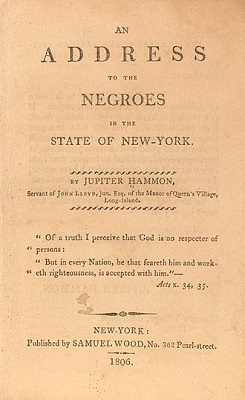
His writings, often composed in verse and rooted in Christian tenets, offered spiritual guidance to both enslaved and free Black people, underscoring concepts of salvation, hope, and redemption. Throughout his life, Hammon produced a range of poems, essays, and speeches, some of which he presented to audiences in New York, frequently centered on themes of piety, redemption, and racial freedom through faith.
As a fervent Christian, Hammon drew inspiration from the religious teachings prevalent during his time, particularly from Puritan and evangelical traditions, which heavily influenced his literary output. His most renowned piece, “A Winter’s Piece” (1782), served as a moral and spiritual contemplation encouraging enslaved individuals to pursue salvation and was published after Hammon gained his freedom in 1770.
Hammon’s works acted as a bridge between the religious narratives of the white establishment and the enslaved Black community, providing spiritual uplift, while subtly questioning the institution of slavery. His writings suggested that true freedom could be achieved through spiritual redemption, and his advocacy for Christian virtues resonated deeply within the enslaved African American population.
Despite his significant literary accomplishments, Hammon remained somewhat isolated within the intellectual circles of his time. He had few contemporaries or mentors who mirrored his literary style, although figures like Phillis Wheatley, another early African American poet, were part of the broader literary landscape. However, Hammon’s religious and moralistic approach was distinct from the classical influences present in Wheatley’s works.
While he did not formally mentor other writers, his creations laid a vital foundation for the emerging African American literary tradition, influencing subsequent writers like David Walker and later abolitionists who stronger voiced their opposition to slavery. Though his influence primarily resided within the religious and moral discourses of his era, Hammon set the stage for a more robust Black literary movement in the years ahead.
Throughout his life, Hammon did not achieve widespread fame or recognition outside the Black community, yet his contributions were instrumental in affirming the presence of African Americans in the literary domain. His work emerged during a period marked by severe racial inequality.
Hammon’s ability as an enslaved man to articulate the moral, spiritual, and intellectual concerns of his community was groundbreaking. Despite lacking formal recognition during his lifetime, Hammon’s legacy has grown in prominence over the years.
Today, Jupiter Hammon is celebrated as a pioneering figure in African American literature, whose work interconnected the intellectual and spiritual lives of enslaved Black individuals with the broader cultural currents of colonial America.