

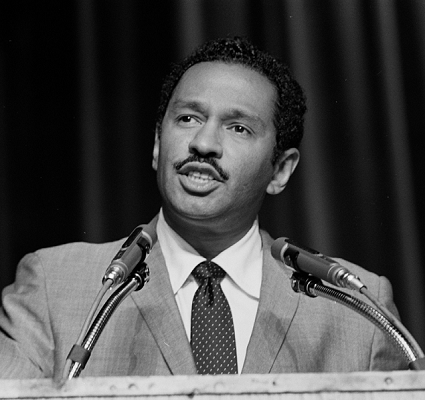
John Conyers


May 16 …
John Conyers was a towering figure in American political life whose more than half-century in Congress left an enduring imprint on civil rights, progressive policymaking, and the moral vocabulary of modern U.S. governance.
Born in Detroit on May 16, 1929 to a working-class family with strong labor ties, Conyers grew up deeply engaged with the social issues that later shaped his political focus. He attended Northwestern High School and subsequently served in the U.S. Army during the Korean War, where he received commendations for his service.
Upon returning home, he pursued higher education at Wayne State University, earning both his bachelor’s and law degrees, and became a member of the bar. His early career included serving as a legislative assistant to John Dingell, a mentorship that honed his legislative instincts and provided access to national politics. Conyers also collaborated with labor unions and worked within Michigan’s workers’ compensation system, grounding his perspective in labor rights and economic justice.
Elected to Congress in 1964, Conyers became one of the longest-serving members in U.S. history and the longest-serving African American in Congress. He was a founding member of the Congressional Black Caucus and emerged as one of its most influential voices.
Conyers’ legislative contributions were vast. He was a pivotal sponsor of the legislation that established Martin Luther King Jr. Day, an early and resolute advocate for reparations for descendants of enslaved individuals, and a strong proponent of universal healthcare through proposals like the United States National Health Care Act. He also played a significant role in shaping civil rights legislation, voting protections, and police accountability measures, demonstrating his lifelong dedication to justice for marginalized communities.
Throughout his career, Conyers was influenced by and worked alongside key figures in American political and civil rights history. He operated within the legacy of leaders such as Martin Luther King Jr., translating their vision into federal policy, and collaborated with contemporaries like Rosa Parks, who notably served on his congressional staff for decades.
Conyers also engaged politically with figures such as Lyndon B. Johnson during the Civil Rights Movement and later with colleagues like Nancy Pelosi and Barack Obama, who he supported early in their national careers. He mentored younger lawmakers within progressive circles and the Congressional Black Caucus, contributing to a lineage of Black political leadership that continues into the 21st century.
Conyers’ lengthy tenure brought both recognition and complexity. He served as chair of the House Judiciary Committee and House Oversight Committee, eventually becoming the Dean of the House, symbolizing seniority and institutional memory. Among his accolades was the Spingarn Medal, awarded by the NAACP for outstanding achievement by an African American.
Conyers was widely regarded as a principled, if sometimes controversial, liberal voice who consistently challenged political norms in the pursuit of equity.
The legacy of John Conyers is intricately woven into the broader narrative of American history — from the Civil Rights Movement to ongoing discussions about justice and democracy — marking him as both a participant in and an architect of transformative change.
