John Carlos


June 5 …
John Carlos is an iconic American athlete and activist whose achievements on the track and courageous stand for human rights helped redefine the role of sports figures in society, leaving a lasting imprint on American sports, culture, and history.
Born on June 5, 1945 in Harlem, NY, he rose from humble beginnings to become one of the fastest men in the world, but it was his moral conviction as much as his speed that secured his place in the national consciousness. Carlos gained prominence while competing for San Jose State College, a track and field powerhouse, where he was guided by the legendary coach Bud Winter and influenced by sociologist Harry Edwards.
Together with his fellow athletes, he became a pivotal figure in a generation that believed excellence in sports could go hand in hand with principled resistance. Carlos’s athletic achievements were remarkable.
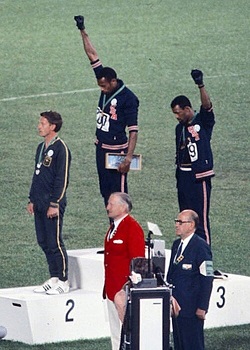
Carlos (right) and Tommie Smith (center) showing the raised fist on the podium after the 200 m race at the 1968 Summer Olympics; both wear Olympic Project for Human Rights badges. Peter Norman (silver medalist, left) from Australia also wears an OPHR badge in solidarity with Smith and Carlos. (photo credit: Angelo Cozzi, Mondadori Publishers)
At the 1968 Olympic Games in Mexico City, he won a bronze medal in the 200 meters, finishing behind his teammate and friend Tommie Smith, as well as Australia’s Peter Norman. The race was historic, but what followed became one of the most enduring images in sports history. During the medal ceremony, Carlos and Smith raised a black-gloved fist to protest racial injustice and inequality in the United States. This silent gesture, often linked to the broader Black Freedom Movement, had significant repercussions — they were expelled from the Games and faced intense backlash at home. Yet over time, the moment evolved into a powerful symbol of peaceful protest and athlete activism.
Beyond the Olympics, Carlos recorded multiple world-class times and was part of the illustrious San Jose State sprint tradition alongside contemporaries like Lee Evans and Bob Beamon, athletes who were pushing the boundaries of human speed and performance.
Carlos drew inspiration from a lineage of trailblazers who combined athletic excellence with social impact. He admired Jesse Owens, whose victories at the 1936 Berlin Olympics challenged racist ideologies on a global stage, and Jackie Robinson, who broke Major League Baseball’s color barrier with dignity and courage. The boldness of Muhammad Ali, who relinquished his heavyweight boxing title for principles, profoundly shaped Carlos’s understanding of standing up for justice.
Simultaneously, he was influenced by the moral leadership of figures like Malcolm X and Martin Luther King Jr., whose appeals for dignity and equality resonated well beyond politics and into locker rooms and stadiums. Carlos and his peers believed that athletes were not merely entertainers but also citizens with voices and responsibilities.
Following the upheaval of 1968, Carlos continued to compete before playing professional football, including stints with the Philadelphia Eagles and the Canadian Football League. Although his athletic career eventually evolved into coaching, counseling, and public speaking, his influence only magnified.
Over the decades, what was once seen as a controversial protest came to be recognized as an act of profound courage. In 2008, Carlos and Smith received the Arthur Ashe Courage Award, affirming their roles as pioneers of athlete activism. They were later inducted into the U.S. Olympic & Paralympic Hall of Fame, and a statue commemorating their medal stand was erected at San Jose State University — an enduring testament to their courage and principles.
John Carlos’s legacy transcends medals and records. He broadened the definition of what it means to be an American athlete, showing that the pursuit of excellence on the field can coexist with a commitment to justice off it. His actions paved the way for future generations of athletes to advocate on issues ranging from racial inequality to human rights, reshaping public expectations about the societal role of sports figures.
Today, John Carlos stands as a symbol of conviction under pressure, a man whose raised fist continues to resonate across decades as both a protest and a promise.