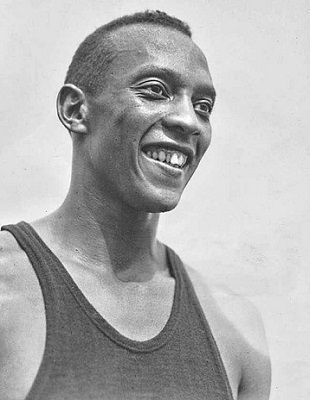
Jesse Owens

September 12 …
Jesse Owens was one of the most iconic athletes in American history, whose achievements transcended sports to become symbols of resistance, dignity, and triumph over adversity.
Listen to this story:
Born James Cleveland Owens on September 12, 1913 in Oakville, AL, he grew up in a time of deep racial segregation and limited opportunities for African Americans. His family later moved to Cleveland, OH, where he began to develop his athletic talent, particularly in track and field. His remarkable speed and agility quickly made him a standout in high school, setting national records and drawing national attention. His potential was evident even before he entered the national stage.
At Ohio State University, Owens earned the nickname “The Buckeye Bullet” and solidified his reputation as one of the greatest athletes of his time. In 1935, during the Big Ten track meet in Ann Arbor, MI, he delivered one of the most extraordinary performances in sports history, setting three world records and tying another in just 45 minutes. That day, he broke records in the 220-yard dash, the 220-yard low hurdles, and the long jump — a feat unmatched before or since. Despite his success, he had to deal with the harsh reality of segregation, often being denied basic accommodations like staying in campus dormitories or eating with white teammates.
Owens’ most famous moment came at the 1936 Summer Olympics in Berlin, held under the Nazi regime. Adolf Hitler intended the Games to showcase Aryan supremacy, but Owens, an African American, shattered that myth by winning four gold medals — in the 100 meters, 200 meters, long jump, and 4×100-meter relay. His victories on German soil, under the gaze of Hitler, were not just athletic achievements, but political statements. Owens’ calm excellence stood in direct defiance of Nazi ideology and made him an international symbol of both athletic prowess and the fight against racial superiority doctrines.
Despite his heroism abroad, Owens returned to a segregated America that failed to honor him in the same way. He was not invited to the White House or publicly recognized by President Franklin D. Roosevelt, and he struggled to find financial stability.
Owens was forced to take up low-paying promotional work and exhibition races, sometimes even racing against horses for money. This period in his life revealed the stark contrast between his international fame and the domestic racism that continued to limit his opportunities. He remained dignified through it all, never allowing bitterness to define his public persona.
In the decades that followed, Owens became an advocate for youth sports and education. He toured the world as a goodwill ambassador during the Cold War, promoting American ideals and the value of sportsmanship. He also worked with underprivileged children and supported athletic programs that emphasized discipline, hard work, and perseverance.
Owens’ message was always clear: sports could be a vehicle for personal and societal growth, and character mattered as much as medals. His belief in the American ideal, even when he had been denied its full benefits, made him a powerful and unifying figure.
Later in life, Owens finally received some of the recognition he had long been denied. President Gerald Ford awarded him the Presidential Medal of Freedom in 1976, the nation’s highest civilian honor. He accepted it with humility, reinforcing his role as a national hero who had endured injustice without ever compromising his principles.
The story of Jesse Owens became part of the American civil rights narrative, illustrating the long journey from exclusion to acknowledgment. His legacy was not only etched in Olympic history, but also in the evolving story of racial progress in America.