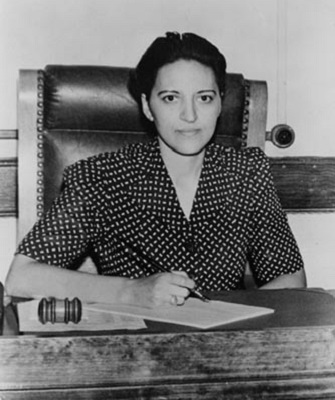
Jane Bolin

April 11 …
Jane Bolin was a woman of many firsts, a determined trailblazer who carved out a path in American history through her dedication to justice and civil rights.
Born on April 11, 1908 in Poughkeepsie, NY, Bolin grew up in a family that valued education, hard work, and service. Her father, Gaius Bolin, was the first African American graduate of Williams College and a practicing attorney — an early influence on Jane’s understanding of the law as both a profession and a tool for change. Despite the barriers of racism and sexism that defined the early 20th century, Bolin excelled in school and set her sights on a career that few Black women had ever dared to imagine.
After graduating from Wellesley College in 1928 — one of only two Black students in her class — Bolin went on to become the first Black woman to earn a law degree from Yale Law School in 1931. Her academic achievements were remarkable not only for their historical significance but for the courage it took to break into spaces where she was often isolated and unwelcome.
Early in her legal career, Bolin worked as a private attorney and later joined New York City’s Corporation Counsel, becoming the first Black woman to serve in that office. These early roles laid the groundwork for a lifetime devoted to dismantling racial and gender discrimination within the legal system.
In 1939, Bolin made history when she was appointed to the New York City Domestic Relations Court by Mayor Fiorello La Guardia, becoming the first Black female judge in the United States. Her appointment was groundbreaking in both its symbolism and its substance.
As a judge, Bolin brought compassion and fairness to family law, overseeing cases involving children and domestic matters. She used her position to challenge discriminatory practices, such as assigning social workers and probation officers based on race and segregating child placement services. Her insistence on equality and dignity for all families redefined the standards of juvenile and family court.
Beyond her judicial responsibilities, Bolin was deeply engaged in politics and civil rights activism. She served on the boards of key national organizations including the NAACP, the National Urban League, and the Child Welfare League of America.
Bolin also collaborated with leaders such as Eleanor Roosevelt, advocating for racial integration, educational reform, and expanded opportunities for marginalized communities. Her political engagement was always grounded in a practical, hands-on approach to change — through the law, through policy, and through education.
Though she was often reluctant to embrace the spotlight, Bolin’s legacy has only grown in significance over time. Her presence on the bench for 40 years helped normalize the idea of women and people of color in positions of legal authority.
Bolin quietly opened doors for generations of lawyers, judges, and public servants who came after her. Her work in family court helped shift the focus of justice toward rehabilitation and fairness, especially for young people and underserved families.
Bolin retired in 1979 but continued to volunteer and support educational causes until her death in 2007 at the age of 98. Her life was not just about breaking barriers but about building systems that worked for everyone.
In the story of American law and civil rights, Jane Bolin is a testament to what perseverance, intelligence, and quiet strength can accomplish. Her legacy remains a cornerstone of both legal progress and the broader movement for racial and gender equity in the United States.