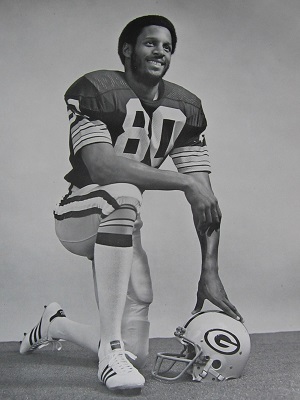
James Lofton

July 5 …
James Lofton is a former professional American football player, coach, and Hall of Fame wide receiver whose playmaking helped define the late-1970s through early-1990s passing era in the NFL. Widely regarded as one of the greatest wide receivers of all time, he made “big-play” receiver excellence a mainstream sports ideal.
Born on July 5, 1956 in Fort Ord, CA, Lofton attended George Washington High School in Los Angeles, where he played multiple positions, then starred at Stanford University. At Stanford, he distinguished himself as both a football receiver and an athlete, clinching the NCAA long jump title in his senior year. This unique dual-sport background foreshadowed the exceptional combination of speed and skill that would define his professional career.
Selected by the Packers as the sixth overall pick in the 1978 NFL Draft, Lofton quickly established himself as one of the league’s most dynamic and feared deep threats during his prime years in Green Bay from 1978 to 1986. Over his 16-season NFL career, he amassed 764 receptions for 14,004 yards and 75 touchdowns.
During his career, Lofton played for the Green Bay Packers, Los Angeles Raiders, Buffalo Bills, Los Angeles Rams and Philadelphia Eagles. He earned recognition as a two-time First-team All-Pro (1980, 1981), made eight Pro Bowl appearances, and was named to the NFL’s 1980s All-Decade Team. His achievements culminated in his induction into the Pro Football Hall of Fame in 2003, and he has been honored by the Green Bay Packers as a Hall of Fame player.
Lofton’s impact on the game transcended statistics. Packers coaches and quarterbacks frequently acknowledged his readiness and skill execution, particularly his ability to stretch defenses vertically and make challenging catches appear effortless. His durability and consistency made him a cornerstone player through various seasons and offensive systems.
Lofton’s key mentors during his Packers career included quarterback Lynn Dickey and offensive coordinator Bob Schnelker, who guided him during a period when he dominated as a deep-threat receiver. His contemporaries — uch as Jerry Rice, Randy Moss, and Larry Fitzgerald — shaped the receiver landscape of the era, while the Packers’ own storied offensive environment featured Hall of Fame quarterbacks and coaching peers who helped transform his talent into a powerful offensive asset.
Following his retirement, Lofton remained connected to football through coaching, serving as a wide receivers coach for both the San Diego Chargers and the Oakland Raiders. This allowed him to influence the next generation of route-runners. Culturally, Lofton became a lasting symbol of the modern wide receiver: precise, confident, and exceptional at creating separation.
The legacy of James Lofton has helped to solidify the notion that elite pass-catching is central to the strategy and entertainment value of American football history.