

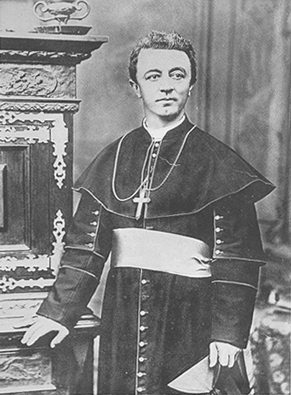
James Augustine Healy

April 6 …
James Augustine Healy holds a unique place in American religious and cultural history as the first known Black Catholic bishop in the United States, though he lived most of his life identified publicly as white.
He was a member of the African-American and Irish-American Healy family, notable for the high achievements of its first generation of children, who were born into slavery in the second half of the 19th century.
Born on April 6, 1830 in Jones County, GA near Macon to an Irish immigrant father and an enslaved African American mother, James Healy and his siblings were legally considered enslaved under Georgia law. However, their father sent them North to receive an education and to escape the legal and social constraints of the South. His siblings were:
- Patrick Francis Healy — first African American Jesuit and university president (the 29th president of Georgetown University);
- Michael Augustine Healy — first African American to command a ship of the United States government; and
- Mary Magdalen Healy — first African American superior of a religious community in the United States.
Healy was educated at the College of the Holy Cross and later at the Sulpician Seminary in Montreal and Paris, where he was ordained a priest in 1854.
Healy’s ministry was deeply shaped by his education and personal experiences, and he quickly rose through the ranks of the Catholic Church due to his intellect, administrative skill, and devotion to service. He served in various academic and clerical roles before being appointed bishop of Portland, ME in 1875, making him the first bishop of African descent in the Catholic Church in America.
Despite his heritage, Healy rarely spoke publicly about race, and his identity was largely accepted in white society due to his appearance and the Church’s policies at the time, which often avoided direct engagement with the complexities of race in America.
As bishop, Healy led the Diocese of Portland for 25 years, overseeing a period of significant growth. He was instrumental in building churches, schools, and charitable institutions across Maine and parts of New Hampshire. He emphasized education and religious instruction, particularly for the growing population of Irish and French-Canadian Catholic immigrants.
Healy’s leadership style was marked by quiet discipline, strong moral standards, and a focus on expanding the Church’s reach in a largely Protestant region. He was also known for his pastoral care and concern for the working class, often advocating for the dignity and welfare of laborers.
Though Healy did not publicly align himself with Black political or social movements of his time, his very existence as a man of African descent in such a prominent ecclesiastical position challenged the racial norms of 19th-century America. His career unfolded during an era of segregation and intense racial prejudice, yet he achieved a level of authority and respect rare for any American, especially one with African ancestry. His life reflects the complex intersections of race, identity, and religion, and it raises important questions about visibility, representation, and belonging in both the Church and society at large.
Healy’s legacy is both remarkable and nuanced. While he did not publicly champion racial justice in the way other figures of African descent might have, his achievements quietly broke barriers and opened doors within one of the most influential institutions in the world. His commitment to faith, education, and service left an indelible mark on the Catholic Church in New England and stands as a testament to his leadership and character.
Today, scholars and religious leaders alike continue to study the life of James Augustine Healy as a window into the complexities of race, faith, and identity in American history.
