

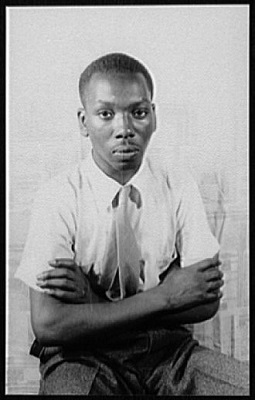
Jacob Lawrence
September 7 …
Jacob Lawrence was one of the most influential American painters of the 20th century, known for his vivid, narrative-driven portrayals of African American life, history, and struggle.
Born on September 7, 1917 in Atlantic City, NJ and raised in Harlem during the height of the Harlem Renaissance, Lawrence developed a visual language that combined modernist aesthetics with powerful storytelling. His work not only documented Black experiences but also elevated them to a central place in the American artistic canon, reshaping the way history and culture are represented through art.
Lawrence’s most renowned body of work is “The Migration Series” (1940–1941), a collection of 60 panels that depicts the mass movement of African Americans from the rural South to the urban North in the early 20th century. Painted when he was just in his early 20s, the series used bold colors, dynamic composition, and simplified forms to convey the emotional and social impact of this transformative event. Rather than focus on individual portraits, Lawrence captured collective experience—displacement, hope, labor, injustice, and resistance — through a style that was both accessible and deeply sophisticated.
Throughout his career, Lawrence used art to spotlight African American figures and episodes that had been largely ignored by mainstream history. His series on Toussaint L’Ouverture, Frederick Douglass, Harriet Tubman, and John Brown brought historical Black leaders to the forefront of American visual storytelling.
These works not only educated audiences, but also asserted that African American history is American history, inseparable from the broader national narrative. In doing so, Lawrence helped lay the foundation for generations of artists who would use their work to challenge exclusion and reclaim representation.
Stylistically, Lawrence bridged modernism and social realism. Influenced by the flat, geometric forms of Cubism and the narrative intensity of muralism, he developed a distinctive style marked by sharp lines, rich color palettes, and rhythmic repetition. He often painted in series, believing that a single canvas could not contain the depth of the stories he wanted to tell.
Lawrence’s work balanced form and function: aesthetically striking while politically and culturally resonant. He made the language of fine art speak in a voice that was rooted in everyday Black life.
Lawrence was also a dedicated educator and mentor, spending many years teaching at institutions such as Pratt Institute and the University of Washington. He believed in the power of art not just as personal expression, but as a tool for communication and empowerment.
Lawrence’s legacy lives on not only in museums and textbooks, but in the practices of artists who continue to grapple with identity, history, and justice through visual means. His contributions helped pave the way for greater inclusion of African American artists in galleries, academia, and public discourse.
Jacob Lawrence’s art remains vital today for its clarity of vision, its historical importance, and its moral urgency. In a time when questions of race, migration, labor, and justice remain at the forefront of American society, his work continues to offer insight and inspiration.
By documenting the past and illuminating the present, Jacob Lawrence left an enduring mark on American culture — one that reminds us that the story of a nation is incomplete without the voices and visions of all its people.
