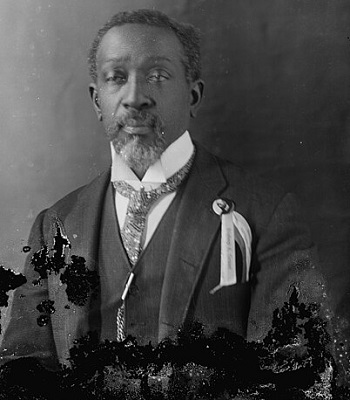
Isaiah T. Montgomery


May 21 …
Isaiah T. Montgomery was a Reconstruction-era political leader, entrepreneur, and town founder best known as the principal founder of the town of Mound Bayou in Mississippi — one of the most significant all-Black towns in the United States.
Born into slavery on May 21, 1847 in Davis Island, MS, Montgomery was the son of Benjamin Montgomery, who managed the plantation of Joseph Davis, brother of Jefferson Davis. The younger Montgomery was fortunate to receive an education uncommon for enslaved children, learning to read, write, and understand business under his father’s tutelage.
After the Civil War, the Montgomery family briefly owned and operated the former Davis plantation, gaining vital experience in large-scale agriculture and commerce before economic challenges forced them to sell. These formative experiences instilled in Montgomery a belief in land ownership, entrepreneurship, and political advocacy as essential means for Black advancement.
In 1887, Montgomery co-founded — along with his cousin Benjamin T. Green — Mound Bayou in the Mississippi Delta, envisioning it as a self-governing, economically independent Black community shielded from the violence and disenfranchisement pervasive in the South. He sought to establish a space for African American self-determination amid the oppressive conditions of Jim Crow Mississippi.
As mayor and a prominent political figure, Montgomery championed agricultural development, banking, education, and small business growth. Mound Bayou became a symbol of Black autonomy, attracting settlers, investors, and national attention. His efforts echoed those of contemporaries like Booker T. Washington, whose philosophy of economic self-sufficiency and adaptation to segregationist politics resonated with Montgomery. Washington viewed Mound Bayou as a practical model of Black enterprise, and the two men maintained a relationship based on shared strategic goals.
Montgomery’s political career, however, was not without controversy. As a delegate to the Mississippi constitutional convention of 1890, he voted in favor of a new state constitution that effectively disenfranchised most Black voters through poll taxes, literacy tests, and other measures. He justified his support as a pragmatic concession aimed at preserving limited political and economic stability for communities like Mound Bayou amidst rising white supremacy.
Critics of the time and since have denounced this choice as a capitulation to injustice, while supporters argue that he was navigating a treacherous political landscape with few alternatives. His position set him apart from more confrontational activists of his era and highlighted the deep divisions within Black leadership during the rise of Jim Crow.
Despite the backlash, Montgomery’s accomplishments in town-building and business development garnered recognition during his lifetime. The town of Mound Bayou in Mississippi thrived for decades as a center of Black enterprise, education, and civic life, attracting visits from national leaders and serving as a model for other independent Black communities.
Montgomery’s life embodied both the aspirations and contradictions of Black leadership in the post–Civil War South, leaving a complex legacy in American business, social justice, and political history. Although Montgomery did not receive formal national accolades in an era hostile to Black political achievement, his leadership ensured a lasting legacy in regional and national history.
The life of Isaiah T. Montgomery the challenging decisions faced by African American leaders in the late 19th century and highlights his significant contributions to the narrative of Black institution-building, economic resilience, and the enduring struggle for equality in the United States.