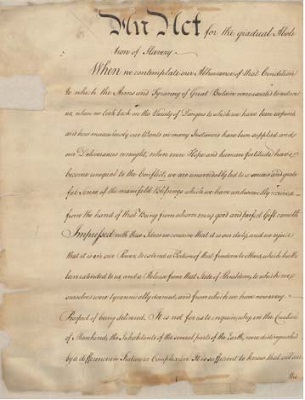
Gradual Abolition of Slavery


March 1 …
An Act for the Gradual Abolition of Slavery was a landmark law passed in Pennsylvania that began the first state-level legislative process to dismantle slavery in the newly independent United States.
Signed into law on March 1, 1780, the act was passed by the Pennsylvania General Assembly during the American Revolutionary period. While it did not directly emancipate all enslaved individuals, it established a legal framework for the eventual abolition of slavery.
The statute mandated that enslavers register those they held in bondage and stipulated that children born to enslaved mothers after the law’s enactment would not be enslaved for life. Instead, they would serve as indentured laborers until the age of 28. This gradual approach reflected the political compromises of the era, attempting to balance the revolutionary ideals of liberty with the entrenched economic interests of slaveholders.
The planning and advocacy behind this legislation involved a network of reformers, legislators, and religious activists. Notable figures included Benjamin Franklin, who later became president of the Pennsylvania Abolition Society; Anthony Benezet, a Quaker educator and early advocate against slavery; and political leaders like George Bryan, who previously championed abolition efforts in Pennsylvania.
Quaker communities had long opposed slavery on moral grounds, and their activism significantly influenced public opinion in Pennsylvania. By the late 1770s, revolutionary rhetoric surrounding natural rights and human equality bolstered the arguments of abolitionists, convincing lawmakers that slavery was antithetical to the principles for which the colonies had fought.
The context of the act reflects Pennsylvania’s diverse social and demographic landscape in the late 18th century. At the time of its passage, around 6,000 enslaved individuals lived in the commonwealth, predominantly in urban centers like Philadelphia and agricultural regions in the southeast. The commonwealth also had a burgeoning population of free Black residents and a robust presence of Quaker and other religious groups that opposed slavery.
The American Revolution heightened discussions on freedom and citizenship, generating political momentum for reform. However, economic interests — especially among farmers and merchants reliant on enslaved labor — ensured that the abolition process would be gradual rather than immediate.
Key stakeholders included both enslaved and free Black Pennsylvanians, slaveholding families, abolitionist organizations, legislators, and religious communities advocating for reform. The primary beneficiaries of the law were the children born to enslaved women after March 1, 1780, who gained a legal pathway to eventual freedom, alongside the growing free Black community that emerged over the following decades.
An Act for the Gradual Abolition of Slavery is now widely acknowledged by historians and civic institutions as the first legislative abolition measure in the United States and a pivotal step in the broader antislavery movement. Its legacy has influenced subsequent laws in northern states and solidified Pennsylvania’s standing as an early center of antislavery activism and African American civic life.