Gordon Parks Sr.

November 30 …
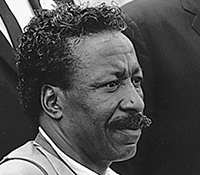
Gordon Parks Sr. was a visionary artist whose work across photography, film, music, and literature helped redefine American culture and challenge its perceptions of race, class, and identity.
Gordon Roger Alexander Buchanan Parks was born on November 30, 1912 in Fort Scott, KS and grew up in a world marked by poverty and racial segregation. These early hardships fueled his creative ambition and sharpened his sensitivity to the injustices that shaped the lives of African Americans. With little formal training, Parks picked up a camera in his 20s and soon discovered a powerful means of expression — one that would elevate him to the forefront of American art and activism.
His rise in photography began when he won a fellowship with the Farm Security Administration in 1942, where he created some of his most iconic early images. Among them was American Gothic, a striking portrait of a Black government cleaning woman posed in front of an American flag with a broom and mop — an image that critiqued racial inequality with subtle power.
Parks had a unique ability to use photography not just to capture reality, but to comment on it. His lens documented the raw beauty, resilience, and dignity of Black life, especially in environments where such stories were often overlooked or distorted by mainstream media.
As the first Black staff photographer for Life magazine, Parks broke barriers and brought new narratives to a national audience. His photo essays on topics like gang violence in Harlem, the Civil Rights Movement, and poverty in Brazil were visually stunning and emotionally searing.
Parks did not simply observe — he immersed himself in the lives of his subjects, gaining their trust and telling their stories with compassion and complexity. His work helped humanize Black communities to readers who might never have engaged with them otherwise, and in doing so, he used visual storytelling as a tool for social change.
Parks extended his talents to film, where he again made history as the first African American to direct a major Hollywood studio production with The Learning Tree in 1969, an adaptation of his own semi-autobiographical novel. The film was a milestone — not just for its representation on screen, but for placing a Black man in creative control behind the camera.
Parks followed up with the iconic 1971 film Shaft, a gritty detective story that introduced audiences to a new kind of Black hero — cool, independent, and unapologetically proud. The success of Shaft helped launch the Blaxploitation era and opened doors for future Black filmmakers.
In addition to his visual work, Parks was an accomplished composer and musician. He wrote classical compositions and film scores, weaving emotion and cultural memory into his music just as he did with his images.
Parks’ interdisciplinary artistry reflected a mind that refused to be confined by boundaries — he moved seamlessly between mediums, always driven by a desire to tell the stories of those on the margins of American life. His artistic output was both prolific and purposeful, a blend of personal vision and political consciousness.
Throughout his life, Parks was honored for his trailblazing achievements and profound cultural impact. His work has been exhibited in major museums, included in permanent collections, and studied in classrooms around the world. He received numerous awards, including the National Medal of Arts.
Parks’ legacy lives on through institutions like the Gordon Parks Foundation, which supports emerging artists and preserves his archive. His influence can be seen in the work of countless photographers, filmmakers, and writers who continue to explore themes of identity, justice, and humanity through the lens he helped pioneer.
Parks was more than an artist — he was a chronicler of the American experience in all its contradictions. He brought light to dark places, dignity to overlooked lives, and beauty to everyday struggle. His work forced America to see itself more honestly, challenging both its failures and its potential.
By telling the stories that mattered, Gordon Parks Sr. not only made history, he helped shape it. His legacy endures as a testament to the power of creativity to awaken, transform, and connect us all.