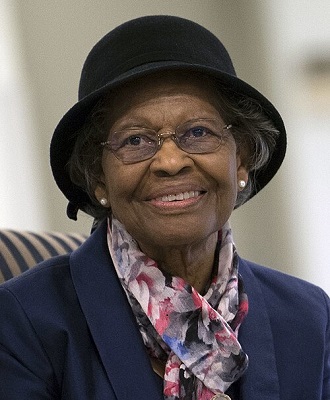
Gladys Brown West



October 27 …
Gladys Brown West was a visionary mathematician whose groundbreaking work in satellite geodesy laid the foundation for the Global Positioning System (GPS), transforming how the world navigates and interacts with space-based technology.
Born on October 27, 1930 in Sutherland, VA, West’s early years unfolded in the segregated South during the Great Depression. It was during this challenging time that her fascination with mathematics was ignited as she honed her skills in counting and calculating. Her academic excellence culminated in her being named valedictorian of her high school class, earning her a full scholarship to Virginia State College (now Virginia State University). There, her passion for numbers and analytical thinking expanded, setting the stage for a groundbreaking career in science and innovation.
After obtaining her bachelor’s and master’s degrees in mathematics, West began her teaching career in segregated schools before making history in 1956 by joining the U.S. Naval Proving Ground in Dahlgren, VA as one of the few Black women in her field. At a time when racial and gender barriers were firmly established, she navigated these challenges through intellectual rigor and quiet determination, mastering early computing systems to tackle complex mathematical problems long before personal computers came into play. She found mentorship in fellow Navy mathematicians and engineers who recognized her exceptional skills, drawing inspiration from pioneers in computational science who understood the importance of precision and perseverance for scientific progress.
Over her 42-year tenure at Dahlgren, West made significant contributions to scientific research, playing a vital role in programming large computers like the IBM 7030 Stretch and leading efforts in mathematical modeling of Earth’s shape — the geoid — by factoring in gravitational variations, tides, and other forces affecting its surface. Her meticulous models enabled satellites to determine positions with unprecedented precision, serving as the foundation for the algorithms that would later become central to GPS technology. Additionally, West managed data analysis projects for early satellite missions like Seasat, which enhanced our understanding of Earth’s oceans, and contributed to award-winning astronomical studies early in her career.
Despite her groundbreaking work, West remained largely unrecognized for decades, much like many other Black women in STEM whose contributions were overlooked in their time. However, as the narrative around “Hidden Figures” emerged, highlighting overlooked scientific achievements, West began to receive the recognition she so rightly deserved.
West became a source of inspiration for contemporaries and future generations of mathematicians, engineers, and scientists, especially women and people of color aspiring to enter underrepresented fields. Her story exemplified the power of dedication and intellectual curiosity in overcoming systemic challenges.
In acknowledgment of her remarkable achievements, West was inducted into the United States Air Force Space and Missile Pioneers Hall of Fame and was named one of the BBC’s 100 Women of 2018, among numerous other prestigious honors celebrating her legacy and impact. Additionally, she earned further degrees in public administration and, after retiring in 1998, completed a Ph.D. at Virginia Tech at the age of 70, reflecting her lifelong commitment to education.
The contributions of Gladys Brown West not only transformed the scientific landscape but also left an enduring mark on American culture and history by helping to develop technologies essential to everyday life — from navigation and timing systems to scientific research and global communications. Her legacy stands as a testament to innovation, resilience, and the profound impact one individual can have on modern society.