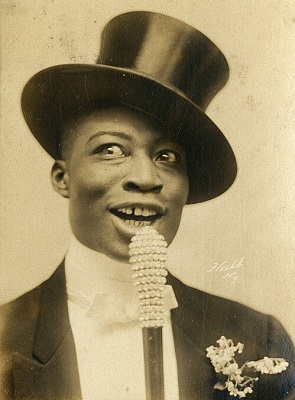
George Walker (Vaudevillian)

June 26 …
George Walker (Vaudevillian) was an actor and producer, and one half of the groundbreaking comedy team Williams & Walker, whose stage work and business initiatives helped transform Black presence on American stages around the turn of the 20th century.
Born on June 26, 1873 in Lawrence, KS, Walker began his career as a performer at a young age by participating in minstrel and medicine shows before settling in San Francisco in the early 1890s. In 1893, he met Afro-Bahamian entertainer Bert Williams, with whom he teamed to form a vaudeville act. They eventually established a production company, appropriately named the Williams and Walker Company.
In 1899, Walker married the talented dancer and choreographer Aida Overton, who became a vital collaborator and significantly influenced the company’s choreography and staging. His early experiences with traveling minstrel troupes and practical training in the vaudeville scene shaped his stage persona as the flamboyant “dandy” and honed his managerial skills.
Walker achieved his most notable successes alongside Bert Williams, with whom he popularized the cakewalk, crafted hit vaudeville sketches and musical comedies such as “Clorindy,” “The Policy Players,” “Sons of Ham,” “In Dahomey,” “Abyssinia,” and “Bandanna Land.” They produced the first full-length Black-produced musical to be staged at a major Broadway venue — In Dahomey in 1902–1903 — which also enjoyed a successful run in London, culminating in a royal command performance before King Edward VII.
Walker took on much of the business and production responsibilities for the Williams and Walker Company, spearheaded initiatives to organize Black performers and aided in creating the infrastructure necessary for the advancement of Black artists’ careers. This included early efforts towards establishing an actors’ society and founding The Frogs, a professional fraternity for Black entertainers.
Walker’s influences and collaborators included composer Will Marion Cook, poet-lyricist Paul Laurence Dunbar, and songwriter Alex Rogers, with Bert Williams standing out as his closest contemporary and creative partner. Mentors and allies in the burgeoning Black musical scene included figures like Bob Cole and J.R. Freeman, along with a wider community of Black vaudevillians and composers of that era.
Among Walker’s contemporaries in vaudeville and musical theatre were Ernest Hogan and various performers from the Keith, Koster & Bial and Broadway circuits. His wife, Aida Overton Walker, was not only a collaborator, but also an artistic peer. His company and The Frogs provided vital networking, mentoring, and professional opportunities that fostered younger Black performers and encouraged elevated production standards.
Walker’s career garnered significant recognition during his lifetime. He and Williams emerged as some of the first major Black recording artists. The success of “In Dahomey” and its subsequent London engagement attracted critical acclaim — notably from some British reviewers and personalities — helped to bring mainstream visibility to Black musical theatre. Also, Walker and his troupe were recorded as freemasons during a 1904 initiation in Scotland.
Walker’s life and career were tragically cut short due to illness after contracting syphilis. He withdrew from performing in 1909 and died in 1911.
The legacy of George Walker (Vaudevillian) continues through the elevated professional standards for Black performers, greater exposure for mixed-race audiences to Black talent, and the foundational groundwork he established for future generations of Black entertainers and producers.