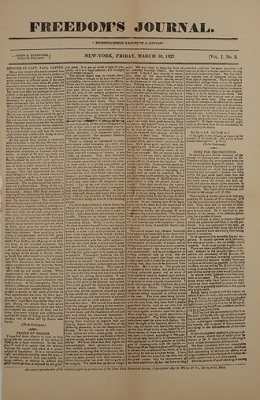
Freedom’s Journal


March 16 …
Freedom’s Journal was the first African American-owned and operated newspaper in the United States.
Established on March 16, 1827 by Samuel Cornish and John B. Russwurm, the publication emerged in direct response to the rampant racism and negative portrayals of Black Americans in mainstream white newspapers. Its bold motto, “We wish to plead our own cause. Too long have others spoken for us,” captured its mission: to give African Americans a platform to voice their experiences, advocate for civil rights, and challenge stereotypes.
The newpaper, founded in New York City, provided a vital space for free Black people to articulate their views on education, slavery, religion, and politics. It published editorials, biographies of notable Black figures, news from Black communities across the country, and international stories relevant to the African diaspora. Its contributors included David Walker (Abolitionist), who shared his views on the evils of slavery.
The publication helped foster a sense of community and collective identity among African Americans during a time when their citizenship and humanity were constantly under attack. It laid the foundation for a Black press that would become a lasting institution in American media.
One of the most significant influences of the Journal was its challenge to pro-slavery rhetoric and white supremacy in American discourse. It not only advocated for abolition but also emphasized the importance of literacy, moral character, and self-improvement in the fight for Black equality. Its editorials promoted the idea that African Americans were not inferior, but victims of an unjust social and political system. This messaging was radical and empowering in an era where slavery was still legal in many parts of the country.
Although the paper lasted only two years, ceasing publication in 1829 due to editorial disagreements and financial struggles, its impact was far-reaching. It inspired the creation of dozens of other Black-owned newspapers in the 19th century, including The North Star by Frederick Douglass and The Colored American (NY). These publications carried forward the Journal’s legacy, continuing to push for abolition, equal rights, and fair representation in the press.
The Journal also had a broader influence on American journalism and the First Amendment tradition. By asserting the right of African Americans to speak for themselves and participate in the democratic process, the publication expanded the definition of press freedom. It demonstrated that journalism could be a tool of liberation and social change, not just a means of reporting events. This idea would shape the role of activist journalism in the United States well into the 20th and 21st centuries.
In historical terms, Freedom’s Journal marked a turning point in the struggle for Black empowerment and self-representation. Its brief, but powerful existence proved that African Americans would not remain silent in the face of injustice. It carved out a place in American history not just as a newspaper, but as a movement — one that helped lay the intellectual and cultural groundwork for the long fight for civil rights that followed.