


Floyd McKissick

March 9 …
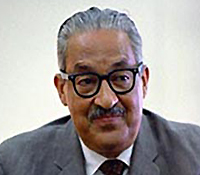
Floyd McKissick was a prominent American civil rights leader, lawyer, and political pioneer whose work helped shape the legal and cultural landscape of the United States during a time of profound social transformation.
Born on March 9, 1922 in Asheville, NC, McKissick grew up in the segregated South, where he experienced firsthand the injustices of Jim Crow laws. His early exposure to racism, combined with a keen intellect and strong sense of justice, motivated him to pursue a career in law — a path that would place him at the forefront of the civil rights movement.
After serving in World War II, McKissick became the first African American to attend the University of North Carolina School of Law in 1951, breaking a major barrier in Southern higher education. This milestone was not only a personal triumph but also a symbolic blow to institutional segregation.
As an attorney, McKissick dedicated himself to civil rights litigation, working closely with the NAACP to challenge discriminatory practices in housing, education, and public accommodations. His legal work provided critical support to the broader movement for racial equality, helping to enforce civil rights legislation through the courts.
McKissick’s national profile rose when he succeeded James Farmer as the director of the Congress of Racial Equality (CORE) in 1966. Under his leadership, CORE underwent a significant ideological shift, embracing Black Power and placing greater emphasis on self-determination and economic justice.
McKissick believed that African Americans needed more than just legal rights — they needed economic empowerment and control over their own communities. His vision helped reshape the civil rights movement during a time when many activists were grappling with frustration over the slow pace of change.
While serving as National Chairman of CORE, McKissick was one of the leaders of the March on Washington in August 1963.
In pursuit of this vision, McKissick launched a bold and controversial initiative: the creation of Soul City, a planned, majority-Black community in rural North Carolina. Backed by federal funding, Soul City was envisioned as a model of economic development and racial self-sufficiency, providing jobs, housing, and services in a region long neglected by mainstream investment. Although the project faced political opposition and economic challenges that ultimately limited its success, Soul City remains a powerful example of visionary leadership and the quest for systemic change through community-building.
McKissick also broke new ground in politics. In 1990, he became a district court judge in North Carolina, continuing his lifelong work of using the legal system to promote fairness and justice. He was a staunch advocate for civil rights until his death in 1991, leaving behind a legacy marked by courage, innovation, and a deep commitment to empowering African Americans through both legal reform and self-reliance. His career was a testament to the belief that lasting change requires both institutional access and independent vision.
McKissick’s contributions to American history are significant and enduring. As a lawyer, activist, and builder, he helped dismantle legal segregation, redefined the goals of civil rights advocacy, and attempted to construct new frameworks for Black empowerment. His work serves as a reminder that the fight for justice is not only about dismantling barriers but also about creating new structures where equity and opportunity can thrive.
Through his bold thinking and relentless pursuit of justice, Floyd McKissick carved a unique and powerful path in the story of American progress.
