

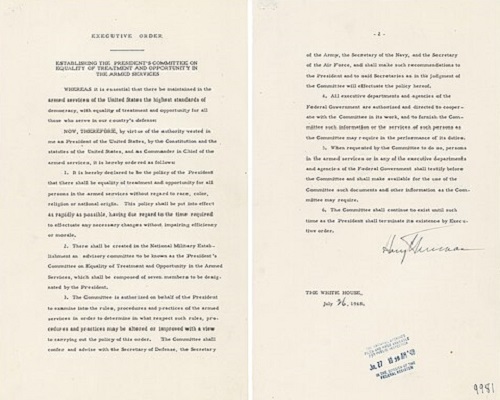
Executive Order 9981



July 26 …
Executive Order 9981, signed by President Harry S. Truman on July 26, 1948, was a landmark decision that desegregated the U.S. military, marking a pivotal moment in the broader struggle for civil rights in America.
The order — which formally mandated the elimination of racial segregation within the armed forces — signified the federal government’s dedication to promoting racial equality during a period when the nation was still profoundly divided along racial lines. This action was a direct response to increasing pressure from civil rights organizations, African American veterans, and political leaders who had long championed equal treatment for Black soldiers, establishing a foundation for future advancements in civil rights.
The signing of the order followed years of advocacy by civil rights groups, particularly the National Association for the Advancement of Colored People (NAACP) and other activist organizations, who had consistently denounced the military’s racial discrimination policies. In the lead-up to the order, President Truman was influenced by a report from the President’s Committee on Civil Rights, which he established in 1946.
This committee, led by Charles Houston and featuring notable members like A. Philip Randolph, aimed to expose systemic racism in American institutions and advocated for reforms, including the desegregation of the military. This order was also part of Truman’s broader efforts to address the mounting racial inequalities evident in the post-World War II era, as the nation wrestled with the demands of an increasingly assertive civil rights movement.
At the time, the U.S. military’s demographics were sharply segregated, with African American soldiers relegated to menial roles and frequently excluded from combat positions. The order mandated the integration of all branches of the armed forces, ensuring that African Americans had equal opportunities for advancement and service alongside their white counterparts.
Key figures in the implementation of the order included military leaders like General Dwight D. Eisenhower, who supported integration, and civil rights advocates like Thurgood Marshall, a fervent proponent of equal rights for Black soldiers. The order received substantial backing from the broader Black community, especially World War II veterans seeking full recognition and rights as citizens.
Although the order did not eradicate all racial discrimination in the military immediately, it initiated a gradual integration process that would unfold over the coming decades. Its legacy is significant, representing one of the first major actions by the federal government to officially confront institutionalized racism in the post-war period.
Desegregation of the U.S. military became a pivotal victory for civil rights activists and acted as a catalyst for further legal and societal transformations in the 1950s and 1960s. The decision to integrate the armed forces set the stage for later civil rights milestones, including the Civil Rights Act of 1964 and the Voting Rights Act of 1965. Truman’s courageous executive action garnered praise from civil rights leaders and helped cement his legacy as a president committed to racial equality.
Executive Order 9981 is widely viewed as a crucial step in the ongoing struggle for racial justice in America.
