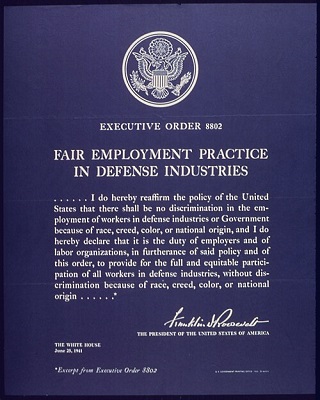
Executive Order 8802


June 25 …
Executive Order 8802 — signed by President Franklin D. Roosevelt on June 25, 1941 — marked a pivotal moment in the history of civil rights in the United States, as it addressed racial discrimination in the defense industry during World War II.
It banned discrimination based on race, color, religion, or national origin in the hiring practices of companies receiving government defense contracts. Its enactment was largely a response to growing pressure from civil rights groups who had been advocating for equitable employment and threatening to organize a March On Washington.
The order became a pivotal moment in the struggle for racial equality, marking the federal government’s first substantial intervention against racial discrimination in employment.
Key contributors to the establishment of the order included A. Philip Randolph, the prominent leader of the Brotherhood of Sleeping Car Porters, who had been at the forefront of efforts to confront discrimination in wartime industries. Randolph’s leadership and activism were crucial in urging President Roosevelt to take action, supported by the advocacy of other civil rights organizations, including the National Association for the Advancement of Colored People (NAACP).
The signing of the order was also influenced by significant advocacy from labor unions, which were increasingly recognizing the vital role of African American workers in the defense industry, particularly as the nation geared up for war. This growing pressure, alongside Roosevelt’s awareness of the need to avert unrest in a wartime America, made the executive order an essential response to both social activism and wartime realities.
The impact of the order was extensive, though not without its shortcomings. The order established the Fair Employment Practices Committee (FEPC) to oversee its enforcement, representing a notable, albeit imperfect, governmental effort to uphold civil rights protections in the workforce. While the FEPC possessed limited power and resources, its creation laid the groundwork for future civil rights advancements in employment and demonstrated the federal government’s recognition of the necessity to tackle systemic discrimination.
Although the order did not eradicate racial inequality in the workforce immediately, it paved the way for future civil rights accomplishments, such as the desegregation of the armed forces and the passage of the Civil Rights Act of 1964.
Fostering greater solidarity between labor movements and African American civil rights advocates, Executive Order 8802 also contributed to a broader cultural shift that acknowledged racial injustice as a national issue demanding legal and political intervention.