

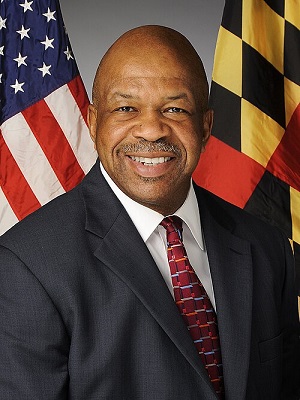
Elijah Cummings



January 18 …
Elijah E. Cummings was a congressman from Maryland whose career blended civil-rights rooted activism, legislative leadership, and moral gravitas, shaping debates over voting rights, government accountability, and urban policy.
Born on January 18, 1951 in segregated Baltimore to parents who had been sharecroppers, Cummings was the third of seven siblings and early on engaged in efforts to desegregate public spaces in his community. He graduated with honors from Baltimore City College High School in 1969 and earned a B.A. in political science from Howard University in 1973, where he actively participated in student government and joined Phi Beta Kappa. He obtained his J.D. from the University of Maryland School of Law in 1976.
After nearly two decades of practicing law, he served in the Maryland House of Delegates from 1983 to 1996, where he was mentored by his predecessor Lena King Lee, who he credited with launching his political career. He won a special election in 1996 to represent Maryland’s 7th District in the U.S. House of Representatives until October 2019.
In Congress, Cummings emerged as a prominent advocate for oversight, civil rights, and social policies focused on constituents. He spent years as the ranking member and, in 2019, became the chair of the House Oversight and Reform Committee, overseeing significant hearings, including those pertaining to the Trump administration and the impeachment inquiry.
Cummings championed voting rights, anti-poverty initiatives, criminal justice reform, and urban renewal projects in Baltimore. His methodology seamlessly blended a rigorous attention to detail with moral persuasion, leveraging committee influence to advocate for government transparency, consumer protection, and the enforcement of civil rights.
Cummings’s legacy is marked by a network of mentorships and relationships, influencing both contemporaries and proteges. He received guidance from Lena King Lee as he launched his political career and collaborated with Congressional Black Caucus members, including John Lewis, as well as fellow Maryland leaders like Kweisi Mfume, who succeeded him in Congress.
Cummings shared impactful ties with influential figures such as Nancy Pelosi and Carolyn Maloney in House leadership and committee work, His wife, Maya Rockeymoore Cummings, emerged as a key leader in Maryland’s Democratic Party. He was widely recognized as a mentor and role model for younger Congress members and local Baltimore leaders who upheld his values of dignity, voting access, and civic engagement.
Cummings’s accolades included numerous honorary doctorates from institutions like Howard University, Morgan State, Johns Hopkins, and the University of Maryland. He also received awards from various civic and legal organizations.
At his passing on October 17, 2019, Elijah Cummings received broad bipartisan recognition, national mourning, lying in state at the U.S. Capitol, and tributes that highlighted his enduring cultural and historical significance as a dedicated advocate for justice and accountable governance.
