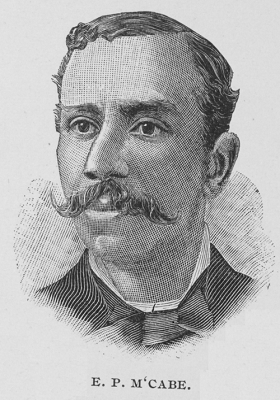
Edward P. McCabe



October 10 …
Edward P. McCabe was a pioneering African American attorney, political leader, and visionary whose efforts in law, governance, community building, and civil rights reflected a deep commitment to expanding opportunity for Black Americans in the post-Civil War United States.
Listen to this story:
From his early days as a government clerk to his groundbreaking election as a statewide official and his ambitious role in founding an all-Black town in the Oklahoma Territory, McCabe exemplified the intersection of political ambition and social justice, significantly influencing African American engagement in public life during a pivotal era in American history. His life mirrored the ideals of empowerment, self-determination, and collective uplift that inspired many Black leaders in the late 19th century.
Born on October 10, 1850 in Troy, NY, McCabe frequently moved as a child throughout the Northeast, living in places like Massachusetts, Rhode Island, and Maine, where he attended school in Bangor until the untimely death of his father curtailed his formal education. To support his family, he took on clerical jobs in New York and Chicago, including a position at the U.S. Treasury office, where he completed his legal education and gained a deep understanding of federal systems.
Influenced by Black Republican organizers and journalists such as Abram T. Hall, with whom he collaborated in Nicodemus, KS, McCabe engaged in law, land agency, and political advocacy within one of the first all-Black frontier settlements. These foundational experiences rooted him in legal practice and the politics of Black community development.
McCabe’s formal political career initiated in Kansas, where his legal acumen and leadership swiftly propelled him into public office. In 1882, he was elected Kansas State Auditor, becoming one of the highest-ranking Black officials in the United States outside the Reconstruction South. Re-elected in 1884, he served two terms as a distinguished Republican leader.
His election showcased the potential for Black politicians to succeed in competitive statewide races, even amidst prevailing racial discrimination. During his tenure, McCabe advocated for both fiscal responsibility and greater African American participation in civic affairs. He shared contemporaneous political circles with figures like John Mercer Langston, whom he later honored by naming the Oklahoma town he would help establish.
After his political career in Kansas, McCabe shifted his focus to the Oklahoma Territory, aiming to foster Black settlement and autonomy in the American West. In 1890, he co-founded the town of Langston in Oklahoma — alongside William L. Eagleson and Charles H. Robbins — on a 320-acre tract near Guthrie as part of a larger initiative to build thriving Black communities where African Americans could own land, create institutions, and govern themselves.
McCabe also initiated the Langston City Herald newspaper in 1891 to promote migration to the territory and foster community solidarity. For a time, his vision included the prospect of establishing an all-Black state. Though that larger goal never came to fruition, his efforts were instrumental in the expansion of Black towns in Oklahoma and the eventual founding of the Colored Agricultural and Normal University in Langston in 1897, now known as Langston University.
McCabe’s broader impact extended to civil rights and governance, serving as Logan County’s first treasurer and as deputy territorial auditor under several governors. In 1908, he contested segregationist “Separate Coach Law” legislation in federal court, asserting that it violated the protections afforded by the Oklahoma Enabling Act, marking one of the early legal challenges against Jim Crow policies.
Despite facing systemic racism and political obstacles — such as being overlooked for the position of territorial governor and losing offices after statehood in 1907 — McCabe’s work inspired subsequent generations of African American leaders and underscored the significance of Black political participation in the post-Reconstruction era.
Though he died on March 12, 1920, the legacy of Edward P. McCabe as a pioneer in law, politics, and community development lives on in the continued existence of the town of Langston in Oklahoma, Langston University, and the enduring narrative of African American resilience and ambition in the American West.