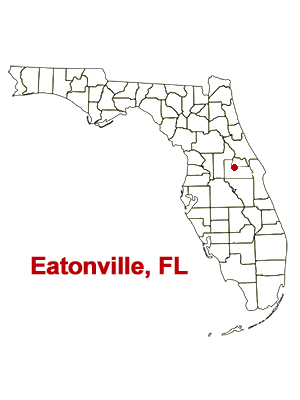
Eatonville, FL

August 15
The town of Eatonville in Florida — nestled just north of Orlando in Orange County — holds a unique place in American history as one of the first self-governing all-Black municipalities in the United States.
Officially incorporated on August 15, 1887, the town was born from the aspirations of African-American settlers — many of them newly freed from slavery — who sought to create a community where they could exercise political autonomy, build economic stability, and establish social institutions free from the pervasive racial discrimination of the post-Reconstruction era. The land that became Eatonville, FL was purchased by Joseph E. Clarke with help from philanthropist Lewis Lawrence and sold by Josiah Eaton, for whom the town is named; this act made possible the incorporation of a municipality governed entirely by Black citizens, with Columbus H. Boger elected its first mayor.
From its earliest days, Eatonville centered around faith, education, and community. The St. Lawrence African Methodist Episcopal Church — founded in the early 1880s — was among the town’s earliest institutions and served as a spiritual and social anchor for residents. Shortly thereafter, the Robert Hungerford Normal and Industrial School was established in 1889 to provide secondary education to Black students at a time when racial segregation sharply limited such opportunities elsewhere in the South. This school, modeled after the Tuskegee Institute and overseen initially by educators from Alabama’s Tuskegee, became a pillar of learning for Eatonville’s youth for over a century before closing due to budget constraints.
Eatonville’s vibrant cultural heritage has been significantly influenced by the arts and literature, particularly through the works of Zora Neale Hurston. As a renowned novelist, anthropologist, and folklorist who spent her formative years in Eatonville, Hurston drew inspiration from her surroundings, most notably in her acclaimed 1937 novel, Their Eyes Were Watching God. This work offers a compelling depiction of African-American life in a small Florida town and has become a foundational piece of American literature. Hurston’s memoirs and folklore collections intricately weave the rhythms and voices of Eatonville’s residents, ensuring the preservation of the town’s stories for generations to come. Since 1990, Eatonville has celebrated Hurston’s legacy with the “Zora Neale Hurston Festival of the Arts and Humanities,” a multi-day event honoring Black culture, arts, and community.
Demographically, Eatonville remains predominantly Black. The 2020 U.S. Census recorded a population of 2,349, with the majority identifying as Black or African American, reflecting its heritage as an African-American town and its lasting cultural identity. While census data reveal population fluctuations over the years, Eatonville’s strong sense of place and community cohesion has enabled it to endure various economic and social challenges. Like many small historic towns, Eatonville has encountered economic difficulties, including median household incomes below national averages and limited commercial infrastructure, notably lacking amenities such as a gas station, supermarket, or pharmacy.
Politically, Eatonville tends to lean Democratic, in line with broader trends among historically African-American communities in Florida and nationally. Voter maps and participation patterns indicate stronger Democratic support compared with more conservative areas nearby, and local civic engagement — especially in elections and cultural events — remains an important element of town life. Eatonville’s government operates under a mayor-council structure, with leaders focused on preservation, community development, and addressing contemporary needs while honoring its historical legacy.
Eatonville, with its rich literary and political heritage, has also been the birthplace of several distinguished individuals across various fields. Apart from Zora Neale Hurston, the town is known as the origin of NFL legend David Deacon Jones, a Hall of Fame defensive end celebrated for his formidable play with the Los Angeles Rams and San Diego Chargers. Additionally, Ha Ha Clinton-Dix, a former professional football safety and later a collegiate director of player development, hails from Eatonville. The town is also connected to actor and singer Norm Lewis, renowned for his exemplary performances on Broadway and beyond, reflecting Eatonville’s impact in diverse cultural realms.
Today, Eatonville, FL strives to maintain its historical significance while adapting to the challenges of the 21st century. It has recently earned the designation of a Florida Main Street community, which aims to promote revitalization and heritage-based economic development. However, parts of Eatonville have also been listed among America’s most endangered historic places by national preservation organizations, emphasizing the struggles that small historical towns face against development pressures, infrastructure changes like the encroachment of Interstate 4, and economic disparities. Local initiatives remain focused on historic preservation, community involvement, and harnessing the town’s unique legacy for sustainable growth and resilience.
Over more than a century of transformation, Eatonville’s narrative is intimately connected to the wider story of African-American self-determination and cultural expression. Its establishment as a self-governing Black town, its pivotal role in nurturing one of America’s most significant literary figures, and its continuous efforts to preserve and celebrate its heritage all contribute to making the town of Eatonville in Florida a remarkable symbol of community, resilience, and the enduring quest for freedom and opportunity.