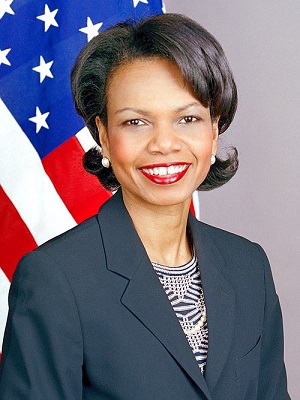
Condoleezza Rice


November 14 …
Condoleezza Rice is a prominent American diplomat, political scientist, and former U.S. Secretary of State, known for her groundbreaking work in foreign policy and her trailblazing role as a woman of color in American politics.
Born on November 14, 1954 in Birmingham, AL, Rice grew up during the civil rights movement in the segregated South. Despite the social and racial challenges of the time, Rice excelled academically, eventually attending the University of Denver and later earning a doctorate in political science from the University of Denver’s Graduate School of International Studies. Her early education and experiences shaped her deep understanding of international relations, making her a respected voice in the world of foreign policy.
Rice’s professional career began in academia, where she taught political science and international relations at Stanford University, eventually becoming the university’s provost. However, her path into government came in the late 1980s when she joined the National Security Council (NSC) during the administration of President George H.W. Bush. She
Rice quickly became a trusted advisor on European and Soviet affairs, displaying an exceptional ability to navigate complex international relations. Her expertise and calm demeanor under pressure earned her recognition, and by the time President George W. Bush entered office in 2001, she had ascended to the role of National Security Advisor.
In 2005, Rice made history when she was appointed the 66th U.S. Secretary of State, becoming the first African American woman to hold the position. During her tenure, she played a pivotal role in shaping U.S. foreign policy in the post-9/11 world, navigating critical global issues such as the wars in Iraq and Afghanistan, the global fight against terrorism, and the promotion of democracy in the Middle East.
Rice’s work was often marked by her staunch advocacy for human rights and her vision for expanding global democracy, even as her policies faced significant criticism from both domestic and international quarters. Her commitment to diplomacy and peace-building was evident in her efforts to broker international agreements and engage with global leaders on matters of security and cooperation.
Despite her high-profile role in U.S. foreign policy, Rice was not immune to controversy. Her support for the Iraq War, especially in the lead-up to the invasion of Iraq in 2003, sparked intense debate. Critics accused her and the Bush administration of overstating the threat posed by Saddam Hussein’s regime and of manipulating intelligence to justify the war.
Additionally, her role in the early years of the War on Terror, including policies related to detainee interrogation, was widely scrutinized. However, Rice remained steadfast in her convictions, arguing that the actions taken were necessary for national security and the promotion of democracy in the Middle East. Her ability to navigate the complex world of international relations during a period of intense geopolitical upheaval solidified her place as one of the most influential figures in American diplomacy.
Beyond her political career, Rice has been a respected voice in academia, business, and public service. After stepping down as Secretary of State, she returned to Stanford University as a professor, where she also co-founded the Center for Comparative Studies in Race and Ethnicity.
Rice’s work in business, including her role on the boards of major corporations, and her advocacy for educational opportunities for underserved communities, further underscores her diverse and multifaceted impact.
As a trailblazer for women and African Americans in the political sphere, Condoleezza Rice continues to be a prominent figure in the global conversation about foreign policy, leadership, and social justice.