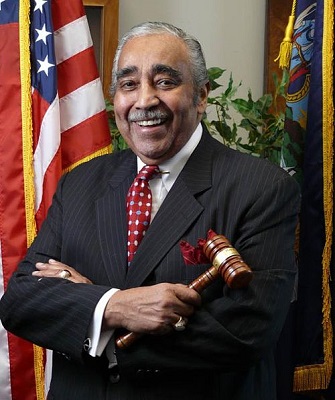
Charles Rangel


June 11 …
Charles B. Rangel was a towering figure in American politics whose decades-long congressional career helped shape national policy on taxation, urban development, and civil rights, while amplifying the political voice of Harlem and marginalized communities.
Born on June 11, 1930 in Harlem, NY, Rangel grew up during the Great Depression in a working-class African American family, facing significant economic challenges from an early age. He left high school to serve in the U.S. Army during the Korean War, where he earned both a Purple Heart and a Bronze Star for his bravery in combat.
After returning home, Rangel took advantage of the G.I. Bill to complete his education, graduating from New York University before obtaining a law degree from St. John’s University School of Law. His experiences of war, poverty, and education profoundly shaped his lifelong commitment to public service and social justice, He was inspired by earlier Black political leaders like Adam Clayton Powell Jr., whose leadership in Harlem influenced Rangel’s political aspirations.
In 1970, Rangel entered politics by defeating Powell in a landmark congressional race, embarking on a tenure in the U.S. House of Representatives that would extend until 2017. Representing New York’s 13th Congressional District, he became a founding member of the Congressional Black Caucus and quickly established himself as a prominent voice on issues affecting urban America.
Over the years, Rangel ascended to the role of chairman of the powerful House Ways and Means Committee, making history as its first African American chair. In this capacity, he played a vital role in shaping major tax legislation, trade policy, and economic reform, with a focus on affordable housing, economic opportunity, and bolstering the social safety net.
Throughout his career, Rangel collaborated with and influenced notable contemporaries such as John Lewis, Shirley Chisholm, and later leaders like Nancy Pelosi and Barack Obama. He was recognized for mentoring younger politicians and nurturing a new generation of leadership, including figures such as Adriano Espaillat, who would eventually take his seat in Congress.
Rangel’s political approach combined sharp wit, extensive institutional knowledge, and a dedication to coalition-building, enabling him to navigate complex political landscapes while championing civil rights and economic justice. His work also resonated with broader cultural movements, as he utilized his platform to tackle inequality and advocate for greater inclusion in American public life. The revitalization of the Apollo Theater in the 1990s exemplified how Rangel’s work enhanced the cultural landscape of Harlem.
Rangel’s contributions garnered numerous honors and accolades throughout his career. In addition to his military decorations, he received the NAACP Spingarn Medal and multiple honorary degrees in recognition of his impact on law, politics, and society — including the Jackie Robinson Foundation’s Lifetime Achievement Award in 2005, Presidential Medal from Baruch College in 2006, and Felton Davis Award of Merit from the New York Association of Chapters of Alpha Phi Alpha Fraternity in 2011.
Despite facing ethical controversies later in his career — culminating in a formal censure by the House of Representatives in 2010 — his legacy remains significant. This is particularly true with his work in advancing African American political influence and shaping national policy.
The life and work of Charles Rangel illustrate the complexities of American democracy and the ongoing struggle for expanded opportunity and representation within it.