

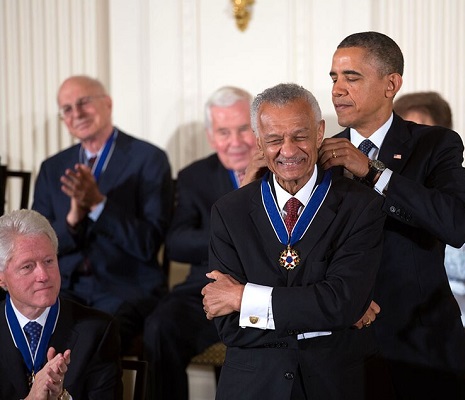
C.T. Vivian


July 30 …
Reverend C.T. Vivian was an American minister, author, and close friend and lieutenant of Martin Luther King Jr. during the Civil Rights Movement.
Born Cordy Tindell Vivian on July 30, 1924 in Howard County, MO, Vivian migrated as a small boy with his mother to Macomb, IL, where he graduated from Macomb High School in 1942. Vivian attended Western Illinois University in Macomb, working as the sports editor for the school newspaper.
Vivian took his first professional job as recreation director for the Carver Community Center in Peoria, IL, where he participated in his first sit-in demonstration, which successfully integrated Barton’s Cafeteria in 1947.
Studying for the ministry at American Baptist College in Nashville, TN in 1959, Vivian met Rev. James Lawson, who was teaching Mahatma Ghandhi’s nonviolent direct-action strategy to the Student Central Committee. Diane Nash, Bernard Lafayette, James Bevel, James Forman, John Lewis, and other students from American Baptist, Fisk University and Tennessee State University executed a systematic non-violent campaign for justice.
On April 19, 1960, 4,000 demonstrators marched on City Hall where Vivian and Diane Nash challenged Nashville Mayor Ben West. As a result, Mayor West publicly agreed that racial discrimination was morally wrong. Many of those students became part of the Student Nonviolent Coordinating Committee (SNCC).
In 1961, Vivian, now a member of the Southern Christian Leadership Conference (SCLC) participated in Freedom Rides replacing injured members of the Congress of Racial Equality (CORE). Vivian was appointed to the executive staff of the SCLC in 1963, when Dr. Martin Luther King Jr. named him national director of affiliates. Two years later during a voter registration drive, Vivian confronted Sheriff Jim Clark on the steps of the Selma courthouse, an incident that made national news when, incensed by Vivian’s impassioned speech, Clark struck Vivian in the mouth revealing his racism to the world.
Vivian wrote the first book on the modern-day Civil Rights Movement in 1969, entitled “Black Power and the American Myth.” During these years, he also started a program entitled “Vision,” sending students from Alabama to college. The program later came to be known as “Upward Bound.”
In 1977, Vivian founded in Atlanta the Black Action Strategies and Information Center (BASIC), a consultancy on multiculturalism and race relations in the workplace and other contexts.
In 1979, along with Anne Braden, Vivian established the Center for Democratic Renewal (formerly the National Anti-Klan Network), an organization where blacks and whites worked together in response to white supremacist activity.
Vivian served as the national deputy director for clergy in the 1984 presidential campaign of Jesse Jackson. And in 1994, he helped establish and served on the board of Capitol City Bank & Trust Company, a black-owned bank in Atlanta, GA.
In 2008, Rev. Vivian founded the C.T. Vivian Leadership Institute, Inc. to create a model of leadership and to train and educate the next generation of grassroots leaders inspired to mobilize a constituency. The Institute is based in Atlanta.
On August 8, 2013, Vivian was awarded the “Presidential Medal of Freedom” by President Barack Obama.
C.T. Vivian died in Atlanta from natural causes just 13 days before his 96th birthday — on July 17, 2020. It was the same day that his friend and fellow activist, John Lewis, died in the same city.
Selected Sources:
- C.T. Vivian Foundation Website.
- C.T. Vivian Interview. The HistoryMakers.
- Wikipedia contributors. “C.T. Vivian.” Wikipedia, The Free Encyclopedia. Wikipedia, The Free Encyclopedia.
