

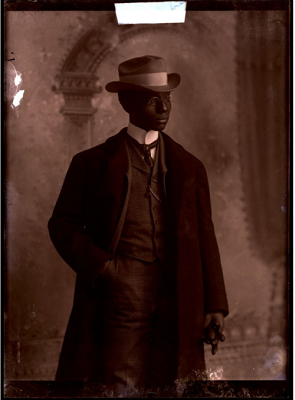
Buck Colbert Franklin




May 6 …
Buck Colbert Franklin was an influential lawyer and civil rights advocate whose legal career and community leadership helped define justice, resilience, and Black empowerment in the early 20th-century United States.
Practicing law during an era rife with racial discrimination and violent repercussions against Black advancement, Franklin devoted his life to safeguarding the rights of marginalized communities, defending property and civil liberties, and championing equality under the law. Beyond his courtroom endeavors, he mentored others, documented crucial historical accounts, and influenced the cultural memory of one of America’s most harrowing events — the Tulsa Race Massacre — through legal advocacy and personal storytelling.
Born on May 6, 1879 near Homer in what is now Pontotoc County, OK, Franklin was the son of David Franklin, a former slave and Union Army veteran, and Millie Colbert Franklin, who had African American and Choctaw roots. Growing up on his family’s ranch, he cultivated a sense of independence, resilience, and community awareness from an early age.
After attending various schools, including Dawes Academy and Roger Williams University, he followed his mentor, teacher John Hope, to Atlanta Baptist College — now known as Morehouse College — where he completed his education in 1903. That same year, he married Mollie Lee Parker.
Initially, Franklin juggled teaching and farming, while pursuing his legal studies through apprenticeships and correspondence courses, showcasing his determination and commitment to self-directed growth. He gained admission to the Oklahoma Bar in December 1907, marking the beginning of an extraordinary legal career that spanned over five decades.
In the early years of his practice, Franklin served the all-Black town of Rentiesville in Oklahoma, where his son historian John Hope Franklin was born. The elder Franklin founded the Rentiesville News newspaper and acted as postmaster general. His legal work involved defending land and mineral rights for Native Americans and freedmen, establishing him as a defender of economic and civil rights for some of the most vulnerable individuals in the area.
In 1921, Franklin relocated to Tulsa’s thriving Greenwood District — known as “Black Wall Street” — where he practiced law with partners I.H. Spears and T.O. Chappelle. Shortly after his arrival, he witnessed and survived the Tulsa Race Massacre, during which white mobs wreaked havoc on homes and businesses, specifically targeting Black residents. In the aftermath, with his office destroyed and his community shattered, he set up a makeshift law practice in a Red Cross tent, tirelessly advocating for the rights of Greenwood residents seeking to rebuild their lives.
One of Franklin’s most significant legal victories came when he challenged a municipal ordinance that sought to prevent Black Tulsans from reconstructing their properties by mandating expensive fireproof construction. Representing Joe Lockard and others, Franklin argued successfully before county judges that the city could not deny property rights without due process, a ruling that enabled residents to commence reconstruction.
He also handled numerous insurance claims and other civil matters for survivors, later presenting cases before the Oklahoma Supreme Court, including a successful challenge against the use of all-white juries in criminal trials. He collaborated with fellow African American attorneys such as I.H. Spears and civil rights-oriented lawyers throughout Oklahoma, all striving to enhance legal protections in spite of systemic racism.
Franklin’s impact extended beyond the legal realm into historical preservation and education. He chronicled his experiences in a manuscript that provided a firsthand account of the devastation in Greenwood — a poignant reflection of the violence and resilience of the Black community. This manuscript was later published posthumously as My Life and an Era: The Autobiography of Buck Colbert Franklin.
His legacy is commemorated through initiatives like the Buck Colbert Franklin Legal Clinic at the University of Tulsa College of Law, which offers free legal services and hosts an annual Civil Rights Lecture in his name, ensuring that his unwavering commitment to justice continues to inspire future generations of lawyers and advocates.
Posthumously, Franklin received accolades such as the W. Thomas Coffman Community Service Award, a testament to his lifelong dedication to service and civil rights.
The influence of Buck Colbert Franklin can be felt not only in the laws he helped develop and the clients he served, but also in the ongoing quest for equity and dignity in American society.
