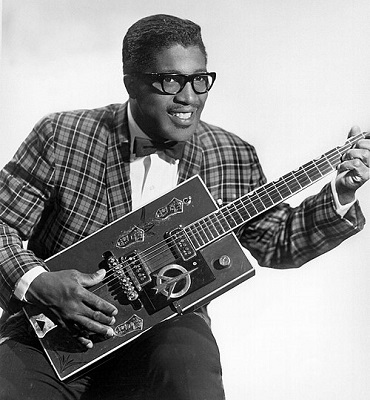
Bo Diddley
December 30 …
Bo Diddley was a pioneering guitarist, singer, and songwriter whose rhythmic innovations and charismatic performances helped invent rock and roll and left an enduring mark on American music and popular culture.
Born Ellas Otha Bates McDaniel on December 30, 1928 in McComb, MS and raised on Chicago’s South Side after being adopted by his mother’s cousin, Diddley began his musical journey by studying trombone and violin in church orchestras before turning his attention to the guitar. While working as a carpenter and mechanic, he honed his craft performing on Maxwell Street and in local clubs, where he developed the distinctive driving pulse that would define his sound.
In the early 1950s, he adopted the stage name Bo Diddley and recorded his first major tracks at Chess Records in Chicago, where the vibrant blend of gospel, blues, and urban rhythms profoundly influenced his style.
Diddley’s impressive career features major R&B hits such as “I’m a Man” and “Who Do You Love?” He invented and popularized the Bo Diddley beat, a 3-2 clave-derived rhythm that underlies countless rock, pop, and hip-hop songs. He brought innovations to guitar sound and performance through techniques like tremolo and reverb, along with his signature rectangular guitars.
Didley’s extensive touring and captivating stage presence — often complemented by longtime collaborator Jerome Green on maracas — further solidified his impact. Spanning from the 1950s into the 2000s, his recording career influenced generations of musicians and helped bridge the gap between blues and mainstream rock.
Diddley’s idols reflected the gospel and blues traditions of his youth, including influential Black performers who shaped urban music scenes. His inspiration came from artists such as Louis Jordan, John Lee Hooker, and Muddy Waters. His mentors and collaborators included Chess Records founders Leonard and Phil Chess, and fellow musicians like Jerome Green and Jody Williams (whom Diddley taught).
His contemporaries featured legends like Chuck Berry, Little Richard, Elvis Presley, and Buddy Holly, along with later British and American rock acts such as The Rolling Stones, The Beatles, and Eric Clapton, all of whom acknowledged his influence. Guitarists like George Thorogood, Keith Richards, and Bruce Springsteen — while not formally recognized as protégés — have credited Diddley for their development as artists.
Diddley’s legacy is celebrated through numerous honors, including his induction into the Rock and Roll Hall of Fame in 1987 and the Blues Hall of Fame in 2003, a Grammy Lifetime Achievement Award, and recognition from the Rhythm and Blues Foundation. He also received later accolades, such as induction into the Rhythm and Blues Music Hall of Fame.
Bo Diddley died on June 2, 2008, but his rhythmic innovations, dynamic performance style, and pivotal role in centering Black American musical forms within global popular music continue to resonate as a foundational aspect of American cultural and musical history.