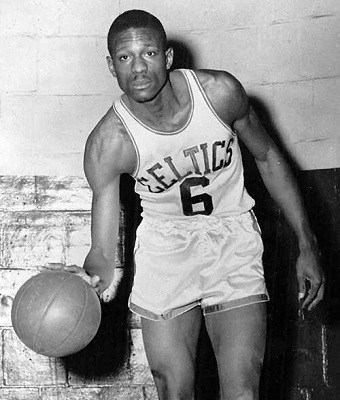
Bill Russell


February 12 …
Bill Russell was a legendary basketball player whose impact on the sport and society extends far beyond his remarkable athletic achievements.
Born on February 12, 1934 in Monroe, LA, Russell grew up in a working-class family that faced the harsh realities of racial discrimination during the Jim Crow era. His family eventually relocated to Oakland, California, where Russell developed a deep love for sports, especially basketball and track.
Overcoming adversity, he excelled in high school athletics and earned a scholarship to the University of San Francisco. There, he made history by leading the USF Dons to two consecutive NCAA championships in 1955 and 1956, showcasing his remarkable talent and determination.
Russell’s professional career began when he was drafted by the Boston Celtics in 1956, quickly becoming a key player for the franchise. During his 13 seasons with the Celtics, he led the team to an unprecedented 11 NBA championships — a record that still stands.
Renowned for his exceptional defensive skills and shot-blocking prowess, Russell revolutionized the center position by prioritizing teamwork and strategy over individual scoring. His fierce competitive spirit and leadership qualities distinguished him as one of the most revered players in the league.
Beyond the basketball court, Russell was an outspoken advocate for civil rights and social justice. Inspired by leaders like Martin Luther King Jr. and Malcolm X, he used his platform to confront issues of racial inequality and discrimination.
While he faced backlash for his views, particularly during his playing days, he remained steadfast in his commitment to enacting social change. Russell’s activism left a significant impact on a generation of athletes, including notable figures like Kareem Abdul-Jabbar and Muhammad Ali, who also leveraged their sports careers to promote social justice.
In addition to his outstanding achievements on the court, Russell left a lasting legacy through his mentorship. He inspired many young players, including Kevin Garnett and Paul Pierce, who credit aspects of their success to his guidance and philosophy of the game.
Russell’s dedication to education and personal development further cemented his role as a mentor and role model within the basketball community. His values of hard work and community service continue to resonate with athletes today.
Throughout his illustrious life, Russell received numerous accolades, including 12 NBA All-Star selections, the NBA MVP award in 1963, and induction into the Naismith Memorial Basketball Hall of Fame in 1975.
In 2011, President Barack Obama honored him with the Presidential Medal of Freedom for his contributions to sports and civil rights.
Russell’s legacy transcends the records he set or the championships he won. It lies in his unwavering pursuit of justice and equality in both sports and society. His journey exemplifies the transformative power of sports, demonstrating how athletic achievement can intersect with social responsibility.
The contributions of Bill Russell to basketball, activism, and mentorship have left an indelible mark on American culture, continuing to inspire future generations of athletes and advocates for equality.