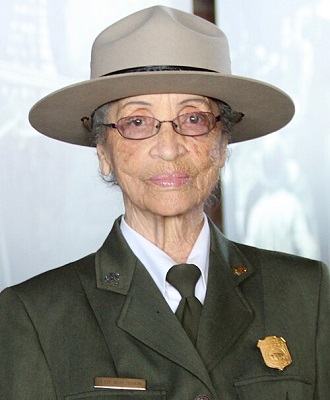
Betty Reid Soskin


September 22 …
Betty Reid Soskin was a historian, activist, songwriter, and National Park Service ranger whose life embodied American adventure through movement, memory, and resilience, making her a singular figure in the nation’s cultural and historical record.
Born in Detroit on September 22, 1921 and raised in California, Soskin witnessed significant events such as segregation, World War II, the civil rights movement, and the 21st century. She harnessed her firsthand experiences from these transformative eras to ensure that the often-overlooked narratives of Black women were preserved and shared.
Soskin’s achievements spanned various fields, but she gained national recognition for her role with the U.S. National Park Service, serving as a ranger into her nineties and becoming the oldest active ranger in U.S. history. At the Rosie the Riveter/World War II Home Front National Historical Park, she reshaped public understanding of the war by highlighting the contributions of Black workers, women, and civilians whose efforts sustained the nation. Through her storytelling, she turned the park into a living history space, intertwining personal narratives with national memory and redefining the concept of historical “adventure” to emphasize endurance and truth-telling rather than conquest.
Prior to her federal service, Soskin was deeply engaged in cultural and political activism. She co-owned a record store that served as a community hub and created music that reflected the experiences of Black life, labor, and resistance. Additionally, she worked as a researcher and legislative aide in California state government, influencing public policy while documenting the systemic exclusions faced by African Americans. Throughout these roles, she persistently challenged dominant historical narratives, advocating for the inclusion of voices that had been marginalized throughout American history.
Soskin drew inspiration from her family’s strong sense of independence, the realities of segregation, and the intellectual traditions of Black feminism and labor history. Although she considered herself outside mainstream movements, she shared connections with contemporaries like civil rights activists, community historians, and cultural figures such as Dorothy Height and Pauli Murray, who similarly fused personal experience with structural critique.
Soskin’s role models were not distant icons but everyday individuals — working women, veterans, and community organizers — whose quiet bravery personified the democratic ideals she believed America should uphold.
Her contributions earned her numerous awards and honors, including national recognition for public service, cultural preservation, and historical interpretation. Beyond formal accolades, Soskin’s legacy endures in her expansion of the meaning of American adventure — from physical exploration to moral courage, and from frontier myths to the realities of struggle.
Betty Reid Soskin stands as a powerful testament to the importance of memory, demonstrating that history is not merely studied but must be actively carried, challenged, and shared across generations.