

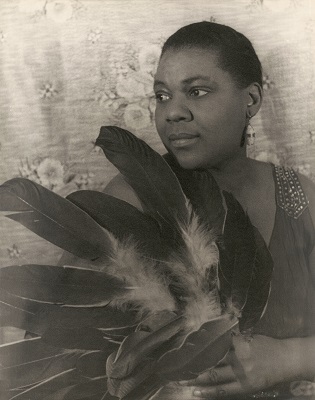
Bessie Smith
April 15 …
Bessie Smith — known as the “Empress of the Blues” — blended rural traditions, spirituals, and jazz into an unmistakable and widely imitated blues style.
Born April 15, 1894 in Chattanooga, TN and growing up in poverty in the South, Smith would likely have remained obscure, but for a 1913 touring show she joined, starring Ma Rainey, one of the first of the great blues singers, from whom she received training. For several years thereafter Smith traveled through the South singing in tent shows, bars and theatres in small towns and cities such as Birmingham, Memphis, Savannah, and Atlanta.
After 1920, Smith settled in Philadelphia, where she was first heard by Clarence Williams of Columbia Records. Smith recorded her first album in February 1923, which included the hit “Down Hearted Blues,” selling more than two million copies.
Smith produced 160 recordings in all — famous tunes like “Tain’t Nobody’s Biz-ness If I Do,” “Careless Love Blues,” “Empty Bed Blues,” and “Nobody Knows You When You’re Down and Out.” She was often accompanied by great jazz musicians like Fletcher Henderson, Benny Goodman, and Louis Armstrong.
Smith was a bold, supremely confident musician whose art expressed the frustrations and hopes of a whole generation of Black Americans. She excelled in delivering the classic subject matter of the blues: poverty and oppression, love — betrayed or unrequited — and stoic acceptance of defeat at the hands of a cruel and indifferent world.
Often disdaining the use of microphones, Smith captivated audiences with her rich contralto voice and her breathtaking emotional intensity. Unfortunately, however, she outlived the popularity of her musical genre. In the late 1920s her record sales and her fame diminished with the Great Depression. She subsequently struggled with alcoholism, which led to a decrease in her performances.
Fortunately, Smith’s appearance in a short motion picture, St. Louis Blues, in 1929 has been since preserved — in 2006 — by the National Film Registry of the U.S. Library of Congress. The film, based on the lyrics of the song that Smith sings, is the only known footage of the artist and shows the emotional power of her performance.
Bessie Smith died September 26, 1937 in Clarksdale, MS, from injuries sustained in a car accident. She was inducted into both the Blues Hall of Fame in 1980, and the Rock and Roll Hall of Fame in 1989.
Footnotes:
- The Editors of Encyclopaedia Britannica. “Bessie Smith.” Encyclopedia Britannica, 9 May. 2025. Accessed 24 June 2025.
- Schomburg Center for Research in Black Culture, The New York Public Library, “African American Desk Reference,” New York: Trade Paper Press, 1999.
