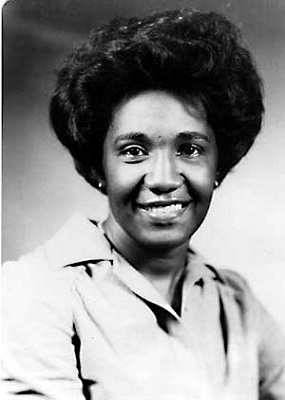
Azie Taylor Morton

February 1 …
Azie Taylor Morton was a trailblazing American public servant whose leadership symbolized the growing presence of African Americans and women in national government during the late 20th century.
Born on February 1, 1936 in the rural community of Dale, TX, Morton grew up in a community molded by the modest realities of segregation and limited educational opportunities in the Jim Crow South. Her mother, who was deaf and non-verbal, relied heavily on the support of extended family, leading Morton to be largely raised by her grandparents, who instilled in her a strong work ethic and a commitment to education.
With limited options for African American students, she attended the Texas Blind, Deaf, and Orphan School in Austin — one of the few institutions available to Black students in the area — and graduated at the age 16. She furthered her education at Huston–Tillotson University, where she earned a Bachelor of Science degree in commercial education in 1956, graduating with honors.
Early in her career, Morton worked as a teacher at a state school for delinquent girls and later served as an assistant to the president of her university, experiences that ignited her passion for social reform, public administration, and community development.
Morton’s entry into national politics was inspired by the reform-oriented atmosphere of the civil rights era. She began her federal service under John F. Kennedy as part of the Committee on Equal Employment Opportunity, gaining valuable insights into civil rights policy and federal administration. This experience paved the way for her work with the Equal Employment Opportunity Commission, where she built strong connections within Democratic Party leadership.
A crucial mentor during her political ascent was Robert Strauss, a prominent political strategist who brought Morton into the Democratic National Committee as a special assistant in the 1970s. Through this position, she collaborated with key political figures shaping the post–civil rights political landscape, including Jimmy Carter and other Democratic leaders involved in national party organization and governance.
On September 12, 1977, President Carter appointed Morton as the 36th Treasurer of the United States, making her the first — and until 2026, still the only — African American to hold this prestigious office.
Serving from 1977 to 1981, her signature graced U.S. currency alongside that of the Secretary of the Treasury, a powerful symbol of changing representation in American government. As treasurer, Morton oversaw the operations related to currency production and government funds and represented the United States at diplomatic events, including international elections and the enthronement of Pope John Paul II.
Following her federal service, she remained active in civic leadership in Austin, TX, contributing to the city’s housing authority and community organizations. She also played a key role in inspiring scholarship initiatives for students at Huston–Tillotson University.
Acknowledged as a pioneer who expanded opportunities for future generations of women and African Americans, Azie Taylor Morton passed away on December 7, 2003. She left us a legacy deeply rooted in resilience, public service, and the continuous expansion of opportunities within American political life.