

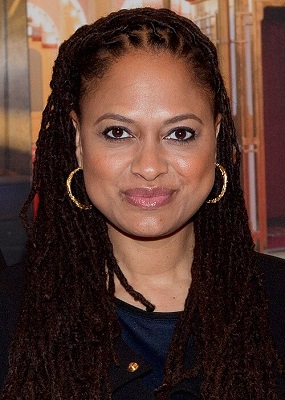
Ava DuVernay

August 24 …
Ava DuVernay is a pioneering American filmmaker, writer, and producer whose work has transformed the landscape of contemporary cinema and elevated the visibility of Black voices in film and television.
Listen to this story:
Born on August 24, 1972 in Long Beach, CA, DuVernay initially pursued a career in journalism and public relations before turning to filmmaking in her early 30s. What began as a personal creative pivot evolved into a groundbreaking career, as she became the first Black woman to win the Best Director Prize at Sundance and the first to direct a film nominated for Best Picture at the Academy Awards.
DuVernay’s rise to prominence began with her 2012 independent film, Middle of Nowhere, which explored themes of love, sacrifice, and incarceration through the story of a woman navigating life while her husband is imprisoned. The film earned her the Best Director award at the Sundance Film Festival, signaling her arrival as a singular cinematic voice.
However, it was her 2014 historical drama Selma that catapulted her into the national spotlight. Chronicling the 1965 voting rights marches led by Dr. Martin Luther King Jr., the film received critical acclaim and brought renewed attention to the Civil Rights Movement through a deeply human and emotionally resonant lens.
As a filmmaker, DuVernay is known for her powerful storytelling and commitment to centering Black lives and experiences with depth and nuance. Her 2016 documentary, 13th, examined the legacy of slavery in the U.S. prison system, earning her an Academy Award nomination and igniting widespread conversation about mass incarceration and systemic racism. With this film, she cemented her role not only as a filmmaker, but as a public intellectual and activist who uses art as a vehicle for social change.
DuVernay continued to break barriers with her 2018 film, A Wrinkle in Time, becoming the first Black woman to direct a film with a budget over $100 million. Although the film received mixed critical reviews, its significance as a cultural milestone — featuring a diverse cast in a genre historically dominated by white narratives — cannot be overstated. Through this work, she proved that stories led by women of color could be positioned at the center of big-budget, mainstream storytelling.
In television, DuVernay has left an equally powerful mark. Her series Queen Sugar and When They See Us demonstrate her continued commitment to complex, community-rooted storytelling. The latter work, which dramatizes the wrongful conviction of the Central Park Five, was hailed for its emotional power and meticulous research, earning numerous awards and raising public awareness about miscarriages of justice. Her work consistently challenges dominant narratives and calls audiences to reckon with the lived realities of marginalized communities.
DuVernay’s contributions to American film, culture, and history extend beyond her creative output. She is the founder of ARRAY, a film distribution collective focused on amplifying stories by people of color and women, and she has become a mentor and advocate for underrepresented filmmakers. Through her art and activism, DuVernay has redefined who gets to tell stories in Hollywood — and how those stories shape the national conversation.
The legacy of Ava DuVernay is one of bold vision, fierce integrity, and an unwavering belief in the power of storytelling to create a more just and empathetic world.
