


April 1 …
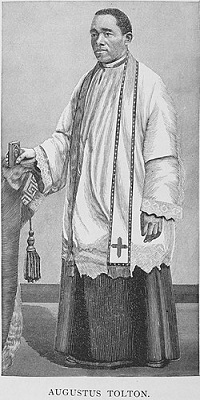
Augustus Tolton was the first publicly recognized African American Catholic priest in the United States, a figure whose life and ministry reshaped American religious history by confronting racism within both church and society while embodying pastoral compassion and perseverance.
Born into slavery on April 1, 1854 in Missouri, Tolton’s early life was shaped by the turmoil of the Civil War. His father escaped slavery to join the Union Army, but tragically lost his life in service, leaving Augustus’s mother to lead her children to freedom across the Mississippi River into Illinois. In Quincy, young Tolton faced both hostility and unexpected allies, experiences that fostered his spiritual resilience and deepened his sense of vocation.
Tolton’s journey to the priesthood was fraught with obstacles due to racial prejudice. He was denied admission to American seminaries because of his race, yet found support from clergy in Quincy who recognized his intellect and commitment. With their encouragement, he traveled to Rome to study at the Pontifical Urban University, where he received rigorous theological training and cultivated a global perspective on the Catholic Church.
Ordained in 1886, Tolton’s ordination was preceded by the ordinations of the Healy brothers — James Augustine Healy and Patrick Francis Healy — Catholic priests who passed as white. He was initially chosen for missionary work in Africa, but church authorities ultimately decided he would serve the Church in the United States. Returning home as a priest, Tolton became a powerful symbol of hope for Black Catholics and challenged entrenched American racial hierarchies.
Assigned to Quincy, IL, Tolton ministered to both Black and white congregants, provoking resentment among certain white clergy and parishioners. Despite facing discrimination, he created a thriving parish community marked by dignified liturgy, compelling preaching, and pastoral outreach.
After being transferred to Chicago, he founded St. Monica’s Catholic Church to serve the influx of Black Catholics migrating to the city. There, he fostered a faith community rooted in sacramental life, education, and social uplift.
His contemporaries included prominent Black Catholic lay leaders and advocates like Daniel Rudd, the founder of the National Black Catholic Congress, who shared Tolton’s commitment to racial justice within Catholicism. Tolton’s ministry coincided with the efforts of leaders like Frederick Douglass, placing him within a larger movement for Black dignity and civil rights.
Tolton’s influences were both personal and theological. His mother’s unwavering faith profoundly shaped his spiritual character, while supportive priests in Illinois mentored him during a time of rejection. In Rome, he discovered the universal dimension of Catholicism, reinforcing his belief that the Church transcended national and racial boundaries, even though American practice often fell short of that ideal.
Although his life was brief and he had little time to cultivate formal protégés, his example inspired Black Catholic families, altar servers, and young men considering vocations. He preached against racial division, insisting that the Catholic Church should be a home for all, and his quiet resilience in the face of prejudice became one of his most profound teachings.
Father Tolton passed away unexpectedly in Chicago in 1897 at the age of 43, succumbing to heat exhaustion after a retreat. Although he received no major accolades during his lifetime, his legacy has grown tremendously over the years.
Today, Tolton is recognized as a Servant of God in the canonization process, and his cause for sainthood has sparked renewed scholarly and devotional interest in his life. His contributions to American religion extend beyond his pioneering status. He demonstrated that holiness and leadership are not limited by race, helped lay the groundwork for Black Catholic institutions, and emerged as a lasting symbol of reconciliation and perseverance.
In the intertwined histories of American Catholicism and the African American struggle, Father Augustus Tolton stands as a prophetic figure whose faith contributed to the pursuit of greater justice and inclusion within the Church.
