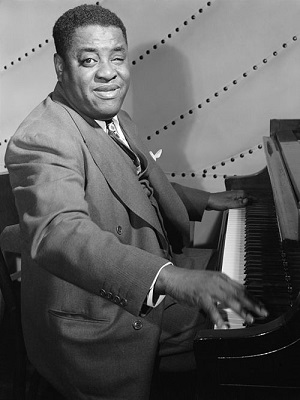
Art Tatum
October 13
Art Tatum was a towering genius in the history of American music, widely regarded as one of the greatest jazz pianists of all time.
Born in Toledo, OH on October 13, 1909, Tatum was nearly blind from birth but showed extraordinary musical ability at a young age. He studied classical music while absorbing the sounds of early jazz, ragtime, and stride piano, developing a technique that seemed to defy the physical limits of the instrument. His combination of lightning-fast runs, harmonic daring, and rhythmic complexity stunned audiences and fellow musicians alike. By the time he reached his twenties, Tatum had already redefined what was possible at the piano.
Tatum’s playing was characterized by its technical virtuosity and rich harmonic imagination. He took the stride piano style pioneered by James P. Johnson and Fats Waller and expanded it, incorporating chromaticism, intricate voice leading, and a unique sense of timing. His interpretations of standards such as “Tea for Two,” “Tiger Rag,” and “Willow Weep for Me” revealed an artist who could reconstruct a tune from the inside out while maintaining its emotional core. His solo performances, especially, were like orchestral compositions in miniature — dense, flowing, and endlessly inventive.
Though primarily a soloist, Tatum also played in trios and jam sessions, influencing nearly every major jazz musician who followed. Icons like Oscar Peterson, Bud Powell, and even classical virtuosos such as Vladimir Horowitz and Sergei Rachmaninoff reportedly marveled at his abilities. While bebop players like Charlie Parker and Dizzy Gillespie were reshaping jazz’s direction in the 1940s, they did so with a deep respect for Tatum’s artistry. His technique and harmonic approach served as a wellspring of inspiration, and his influence extended well beyond jazz into classical and popular music.
Tatum’s contributions went beyond musical technique; he helped elevate the status of the jazz pianist from background accompanist to central artistic force. At a time when African American artists often faced limited opportunities and recognition, Tatum’s brilliance demanded respect from even the most elite musical circles. He toured widely, performed in prestigious concert halls, and recorded extensively, leaving behind a vast catalog that continues to astonish listeners and musicians. His presence in segregated America was a powerful reminder of the intellectual and creative capacities of Black musicians, challenging racist assumptions through sheer excellence.
Art Tatum passed away in 1956, but his legacy remains deeply embedded in the DNA of jazz and American musical culture. He expanded the language of the piano and proved that jazz could be as virtuosic and complex as any classical form. His recordings are still studied and celebrated for their unmatched artistry, and his name continues to symbolize the highest level of musical achievement.
Art Tatum was more than a performer — he was a revolutionary voice in American music, forever altering the way we understand the piano and the potential of human expression through sound.