


February 11 …
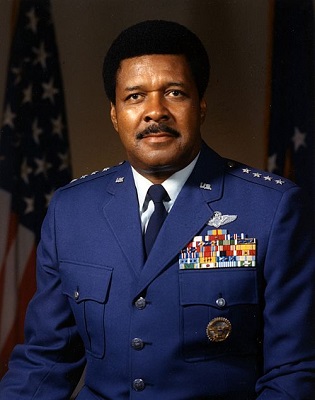
Chappie James was a pioneering American aviator and military leader whose career reshaped the landscape of U.S. aviation and symbolized the expanding promise of equality within the armed forces.
Born Daniel James Jr. on February 11, 1920 in Pensacola, FL — a city closely tied to naval aviation — James was raised in a household that prioritized education, patriotism, and perseverance. His father, an Army officer, instilled a deep respect for service, while the pioneers of Black aviation inspired his dreams of flying, even amid the racial segregation that limited access to military cockpits.
Driven to break through systemic obstacles, James entered aviation through the historic training program that produced the Tuskegee Airmen, setting the stage for a career characterized by technical excellence and groundbreaking achievements. During World War II, he trained as a fighter pilot and later served in the Korean War, executing combat missions that showcased his skill and composure under pressure.
As one of the pioneering African American military aviators linked to the legacy of the Tuskegee Airmen, he helped demonstrate that excellence in aviation knew no racial bounds. His operational experience spanned from propeller-driven aircraft to the onset of the jet age, mirroring the rapid technological advancements in American airpower.
Over the years, James took on increasingly complex command roles, blending strategic insight with a steady leadership style that garnered respect from both peers and subordinates. In 1975, James reached a historic milestone when he was promoted to four-star general, becoming the first African American to achieve this rank in any branch of the U.S. armed forces.
As commander of the North American Air Defense Command (NORAD) and the Continental Air Defense Command, he oversaw vital Cold War air defense operations, protecting U.S. and Canadian airspace during a time of heightened geopolitical tension. His leadership coincided with broader initiatives to integrate and professionalize the armed forces in the post–civil rights era.
Contemporary figures like Colin Powell and pioneering military nurses such as Hazel Johnson-Brown were similarly broadening the scope of minority leadership in uniform, collectively representing a generation that reshaped both policy and perceptions within the U.S. military.
Beyond his operational successes, James became a cultural symbol of disciplined patriotism and principled leadership. He often spoke about national unity, personal responsibility, and the importance of merit-based opportunity. His visibility as a four-star general challenged long-standing stereotypes and contributed to evolving cultural narratives surrounding race, authority, and service.
Inspired by earlier pioneers who paved the way for integrated armed forces, he became a role model for young Americans aspiring to careers in aviation and public service. His speeches and public engagements reinforced the notion that military service could bridge communities and serve as a proving ground for democratic ideals.
Throughout his illustrious career, James received numerous honors, including the Defense Distinguished Service Medal, Air Force Distinguished Service Medal, Silver Star, Distinguished Flying Cross, and multiple awards for meritorious service. These accolades reflected both his valor in combat and his excellence in command.
After retiring in 1978, James continued to shape national conversations about leadership and civic duty until his passing later that year, shortly after retirement.
The legacy of Chappie James lives on, not only in the history of American aviation but also in the broader narrative of the nation’s continuing pursuit of equality and excellence, marking him as a transformative figure in military, cultural, and historical memory.