
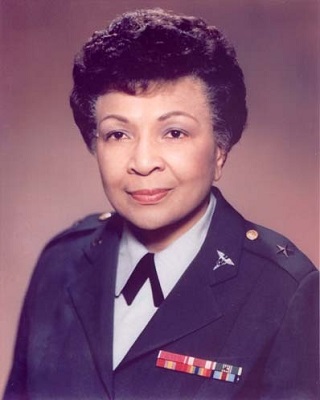
Hazel Johnson-Brown


October 10 …
Hazel Johnson-Brown was a transformational leader in American healthcare and military history, becoming the first Black woman general in the United States Army and redefining both the scope of military nursing and the possibilities for women of color in uniform.
Born on October 10, 1927 in West Chester, PA, Johnson-Brown grew up in a segregated America with limited professional opportunities for Black women. Inspired by the discipline of military service and the achievements of Black professionals who utilized education as a means of empowerment, she aspired to become a nurse from an early age.
Johnson-Brown’s unwavering commitment to academic and professional excellence propelled her into the upper echelons of Army medicine, where she left an enduring impact on national healthcare systems and institutional culture. Commissioned into the Army Nurse Corps in 1955 after obtaining her nursing degree, she ascended through clinical and administrative positions, garnering a reputation for her intellectual rigor, organizational skills, and high standards.
Johnson-Brown pursued advanced education in nursing education and administration, enhancing her ability to influence both policy and practice. During the Vietnam era and the significant reforms that followed, she played a crucial role in modernizing Army medical services, focusing on professional development, research, and evidence-based practice.
In 1979, Johnson-Brown made history when she was appointed Chief of the Army Nurse Corps and promoted to brigadier general, becoming the first Black female general in the United States Army and the first Black chief of the United States Army Nurse Corps. This was a milestone that transcended the military and symbolized progress in the long fight for racial and gender equity. She was also the Director of the Walter Reed Army Institute of Nursing.
As Chief of the Army Nurse Corps, Johnson-Brown supervised thousands of nurses stationed around the globe, developing recruitment strategies, expanding leadership training, and elevating clinical standards in military hospitals. She championed continuing education and advanced specialization, understanding that the complexities of modern warfare and global deployments required a highly skilled nursing workforce.
Johnson-Brown’s tenure coincided with significant societal changes in America, including the integration of women into expanded military roles. She worked diligently to ensure that nurses were recognized not only as caregivers but also as strategic leaders in healthcare delivery.
Her contemporaries, such as trailblazer Nancy Leftenant-Colon in the Air Force, represented a generation of Black military nurses who broke down long-standing barriers across service branches.
Johnson-Brown’s influence also reached into civilian society and culture. As a prominent role model in the post–civil rights era, she frequently spoke on leadership, discipline, and education as essential tools for social mobility. She admired the pioneers who paved the way for her and, in turn, became an inspiration for younger officers and nursing students, who viewed her career as a path to both service and authority.
Her leadership style blended compassion with accountability, reinforcing the notion that excellence in healthcare is intrinsically linked to ethical responsibility and cultural competence. By attaining a general’s rank, she reshaped public perceptions of military authority and contributed to broader shifts in American cultural narratives regarding race, gender, and patriotism.
Throughout her distinguished career, Johnson-Brown received numerous military decorations and professional honors recognizing her service, leadership, and commitment to nursing excellence. Her accolades included the Army Distinguished Service Medal and multiple commendations for meritorious service, along with recognition from nursing associations and educational institutions.
Even after her retirement from active duty, she remained dedicated to advocating for veterans, nurses, and minority leadership development.
The life story of Hazel Johnson-Brown represents a powerful chapter in American history, illustrating how perseverance, education, and principled leadership can transform institutions and inspire generations across healthcare, the military, and the wider fabric of society.