

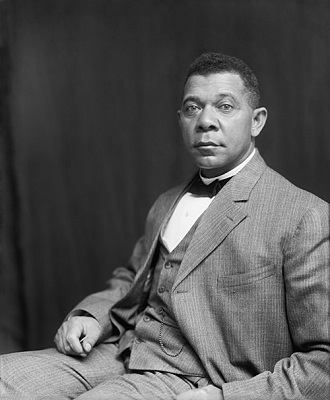
Booker T. Washington


April 5 …
Booker T. Washington was one of the most influential African American leaders of the late 19th and early 20th centuries, best known for his work in education and his philosophy of racial uplift through self-help, industrial training, and economic development.
Born into slavery on April 5, 1856 in Hale’s Ford, VA, Washington experienced the harsh realities of enslavement and the challenges of Reconstruction firsthand. After emancipation, he worked his way through school, eventually attending and graduating from the Hampton Institute, where he embraced the value of hard work, discipline, and vocational training — principles that would shape his life’s mission.
In 1881, Washington became the founding principal of the Tuskegee Normal and Industrial Institute (now Tuskegee University) in Alabama. Under his leadership, Tuskegee became a model institution for Black education in the South.
Washington emphasized practical skills such as farming, carpentry, brick-making, and domestic science, believing that economic self-sufficiency was the foundation for racial progress. By training Black students in trades and agriculture, Washington hoped they would gain the respect of white Americans and gradually achieve greater social and political equality.
Washington’s approach, often referred to as “accommodationism,” was both strategic and controversial. He believed that African Americans should not aggressively demand civil rights but instead focus on improving themselves through education and economic productivity. His most famous articulation of this philosophy came in the 1895 Atlanta Compromise speech, where he called for Black people to “cast down their buckets” where they were and prove their worth through industry and integrity. He assured Southern white leaders that Black people would not agitate for social integration or political power in exchange for economic opportunities and basic education.
Despite criticism from more radical Black leaders like W.E.B. Du Bois and Monroe Trotter, Washington wielded significant influence both within the African American community and among white philanthropists and politicians. He became an advisor to several U.S. presidents and used his connections to secure funding for Black schools and institutions across the country. Behind the scenes, he also supported legal challenges to segregation and quietly aided civil rights efforts, showing that his public stance was more nuanced than many assumed.
The impact of Washington on American education was profound. He trained generations of African American teachers, craftsmen, and leaders who went on to uplift their communities throughout the segregated South. His belief in self-reliance and racial pride instilled a strong sense of purpose in many Black Americans during a time of widespread oppression and limited opportunity. Tuskegee’s success also demonstrated that Black institutions could thrive with strong leadership and community support.
Washington’s legacy is complex, but undeniably significant. While his methods and message were shaped by the constraints of his era, his contributions laid the groundwork for future progress in education and civil rights.
Booker T. Washington was a masterful organizer, a gifted speaker, and a tireless advocate for Black advancement. His life story — from slavery to the White House — embodied the possibilities of perseverance, education, and strategic leadership in the face of systemic racism.
