
August 16 …
The Black Guards of Maine were an African American military unit formed during World War I whose service reflected both the patriotism of Black soldiers and the persistence of racial inequality in the U.S. military.
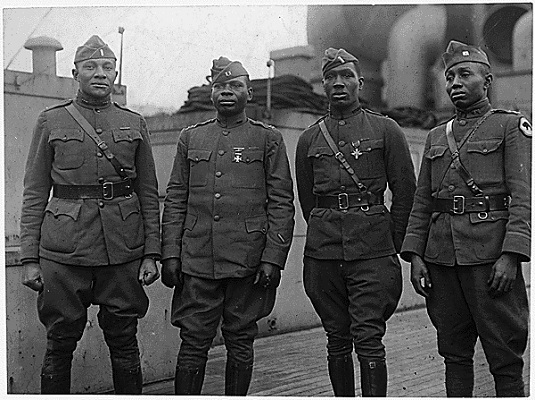
Officially designated the 366th Infantry Regiment — a segregated African American regiment of the 92nd Infantry Division of the U.S. Army during the mobilization of World War I — the regiment was established on August 16, 1917. Drawing predominantly from African American communities in New England, including Maine, it earned the nickname “Black Guards of Maine.”
The 92nd Division was created amidst a growing demand from African Americans for greater inclusion and recognition in national service, even as segregation and discrimination persisted as official policies. The regiment’s origins highlight both the wartime opportunities and the structural inequalities that shaped the African American military experience.
The 366th Infantry comprised a mix of officers and enlisted personnel, with Black soldiers primarily serving under white officers, a practice prevalent in the segregated army. The division operated under the broader command of General John J. Pershing, leader of the American Expeditionary Forces.
Like other units in the 92nd Division, the 366th Infantry trained in the U.S. before their deployment to France, where African American troops frequently encountered skepticism regarding their combat capabilities. Despite these obstacles, the soldiers upheld a legacy of service established by earlier Black military units and were contemporaries of other distinguished regiments, such as the celebrated 369th Infantry Regiment — the Harlem Hellfighters — known for its remarkable combat achievements.
The 92nd Infantry was the only African American infantry division that participated in combat in Europe during World War II. The service of the 366th Infantry contributed significantly to the broader efforts of the 92nd Division in France and marked an essential step in the ongoing struggle for equality within the U.S. armed forces.
The regiment’s existence challenged prevailing stereotypes about African American capability and loyalty, even as its soldiers faced discrimination, unequal training opportunities, and limited chances for distinction. Their involvement helped pave the way for future advancements, including the eventual desegregation of the military in 1948, and influenced shifting perceptions of Black service members in American society and culture.
The legacy of the 366th Infantry Regiment resides in their pivotal role in the first large-scale mobilization of African American troops in modern U.S. history. Although the unit did not receive the same recognition or accolades as some more widely recognized regiments, its collective contributions hold substantial significance in American military history.
The Black Guards of Maine are a testament to the resolve of Black soldiers to serve their country despite systemic barriers, occupying an important place in the interconnected narratives of military service, civil rights, and the ongoing pursuit of equality in the United States.
Photo credit:
Officers of the United States Army’s 366th Infantry Regiment on board the RMS Aquitania, en route home from World War I. From left to right: Lt. Cleveland Abbott (Yankton, SD); Capt. Joseph Lowe (Pacific Grove, CA); Lt. Aaron Fisher (Lyles, IN), recipient of Distinguished Service Cross; and Capt. E. White (Pine Bluff, AR).