
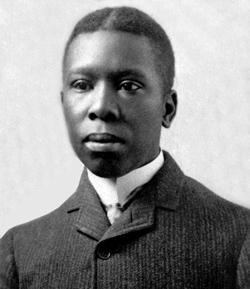
Paul Laurence Dunbar

June 27
Paul Laurence Dunbar emerged to become one of the most influential voices in American literature at the turn of the 20th century.
Born on June 27, 1872, in Dayton, OH, to parents who had been enslaved in Kentucky prior to emancipation, Dunbar grew up immersed in the rich narratives and traditions of Black American life, which would become central to his writing. As a student, he stood out as the sole African American in his high school class, excelling as class poet, editor of the school newspaper, and president of the literary society — early indicators of the remarkable literary talent that would soon capture national attention.
Dunbar’s formative influences ranged from the Romantic poets he deeply admired — such as Keats, Wordsworth, Whittier, and Longfellow — to the vibrant oral traditions of African American speech and song that he internalized at home and in his community. Initially aspiring to pursue law, Dunbar was redirected by racial discrimination and financial limitations, eventually finding work as an elevator operator. Despite the challenges, he continued to write and sell his early poetry collection, Oak and Ivy, to passengers in order to finance its publication. Encouragement from local figures like poet James Newton Matthews, along with a supportive letter from James Whitcomb Riley, helped introduce his work to a wider audience, paving the way for greater recognition.
His second collection in 1895, Majors and Minors, propelled Dunbar to national prominence, in part due to the enthusiastic, albeit complex, endorsement from influential critic William Dean Howells, whose review brought Dunbar’s poetry to readers both in the United States and abroad. Demonstrating remarkable versatility, Dunbar wrote both in standard English and in African American dialect, captivating audiences while igniting debates about representation and stereotypes. His dialect poems, infused with the rhythms and voices of everyday Black life, showcased dignity and depth, while his standard verse delved into universal themes of human emotion and resilience.
Dunbar’s work resonated on an international scale; a six-month reading tour in England enhanced his reputation, and influential poems like “We Wear the Mask” and “Sympathy” — the latter containing the profound line “I know why the caged bird sings” — secured his lasting place in the literary consciousness of future generations. Collaborations with musicians and playwrights, including operettas and song lyrics, reflected his far-reaching impact on American cultural life and foreshadowed developments in musical theater. Composers such as William Grant Still and Florence Price brought his poetry to life through music, ensuring that his words transcended the printed page.
Although Dunbar’s life was tragically cut short due to tuberculosis in 1906 at the age of 33, his prolific output included hundreds of poems, numerous short stories, novels, essays, and song lyrics. His fiction, particularly The Sport of the Gods, gave early voice to the challenges faced by African American families migrating northward amidst social and economic upheaval.
Dunbar’s literary accomplishments helped pave the way for the Harlem Renaissance, inspiring later writers like Langston Hughes, Zora Neale Hurston, Maya Angelou, Nikki Giovanni, and James Weldon Johnson, who drew from his example to assert a Black literary identity in the national discourse.
Prominent figures such as Frederick Douglass, who referred to Dunbar as “one of the sweetest songsters his race has produced,” and the novelist and critic Howells, who praised his poetic mastery, were among those who championed his work. Support from patrons like attorney Charles A. Thatcher and psychiatrist Henry A. Tobey in his early career provided the financial and logistical support that helped bring Dunbar’s work into print and into the public eye, illustrating a network of mentors and supporters dedicated to his success.
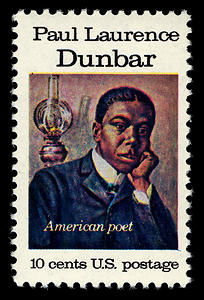
United States postage stamp of 1975 depicting Dunbar
In the years following his death, Dunbar has received enduring honors and recognition. Schools, libraries, and cultural institutions across the country bear his name, and his Dayton home has been preserved as a historical site celebrating his life and legacy. His influence is evident in the titles and themes of later works, most famously in I Know Why the Caged Bird Sings by Maya Angelou, which draws directly from his poetry. Literary scholars continue to study and celebrate Dunbar’s accomplishments, establishing his work as a foundational chapter in American literature.
Dunbar redefined American letters by articulating the intricacies of Black experience with artistry, compassion, and technical skill. He was the first African American writer to achieve widespread national acclaim and to sustain himself through his writing, breaking barriers for those who came after him.
The legacy of Paul Laurence Dunbar endures not only in the writings he left behind, but also in the generations of artists and readers inspired by his vision — a voice that bridged cultures and expanded the possibilities of American literature.