
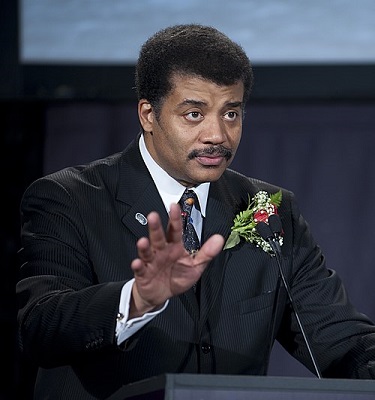
Neil deGrasse Tyson

October 5 …
Neil deGrasse Tyson is an astrophysicist, author, and prominent science communicator who has shaped public understanding of astronomy and the role of science in society.
Born on October 5, 1958 in New York City, Tyson attended the Bronx High School of Science. He went on to earn a BA in physics from Harvard University, an MS in astronomy from the University of Texas at Austin, and both an MPhil and PhD in astrophysics from Columbia University, where he was mentored by R. Michael Rich. His passion for astronomy was sparked by early experiences at the American Museum of Natural History’s Hayden Planetarium.
Following his postdoctoral work at Princeton University, he became closely associated with the Hayden Planetarium, serving as its director from 1996. He founded the Rose Center for Earth and Space’s modern programming.
Tyson’s remarkable achievements encompass extensive research on galactic structure and stellar populations, overseeing the multimillion-dollar renovation of the Hayden Planetarium. He wrote bestselling popular science books, such as Death by Black Hole, The Pluto Files, and Astrophysics for People in a Hurry.
Tyson has also played significant roles in the media, including as the host and executive producer of Cosmos: A Spacetime Odyssey, host of NOVA ScienceNOW, and creator/host of the StarTalk radio and TV franchises. These shows have greatly enhanced public engagement with science and elevated the cultural prominence of astronomy.
Throughout his career, Tyson has drawn inspiration from various influences and mentors, including the influential presentations at the Hayden Planetarium during his childhood and guidance from astronomers like R. Michael Rich. He often cites Carl Sagan as a significant intellectual influence and has collaborated with contemporaries such as Lawrence Krauss and his fellow producers and writers from Cosmos, who carry on Sagan’s legacy of public science communication.
Tyson has shaped the next generation of science communicators, cultivating protégés and collaborators across multiple media platforms. His impact is also reflected in the careers of his children, students, and numerous public-facing scientists who credit his mentorship, though formal names of protégés are not frequently documented.
Among Tyson’s many accolades are the NASA Distinguished Public Service Medal, National Academy of Sciences’ Public Welfare Medal, Klopsteg Memorial Award, Isaac Asimov Award, being elected a Fellow of the American Physical Society, multiple honorary doctorates, and Time’s recognition as one of the 100 most influential people in 2007. Also, asteroid 13123 has been named after him.
Tyson’s public career has not been without controversy. He has faced multiple allegations of sexual misconduct, which were investigated by employers, leading to temporary suspensions of some broadcasts and projects before their eventual resumption after internal reviews. Nevertheless, his blend of rigorous scientific training, showmanship, and unabashed curiosity has energized public conversation about the cosmos and the scientific method. His work as a scientist, educator, and communicator has left a lasting imprint on public science literacy and the cultural place of astronomy.
By translating complex ideas into vivid metaphors, championing science education, and leveraging popular media and public appearances, Neil deGrasse Tyson has inspired countless educators and learners to view science as both accessible and essential. His work strengthens the cultural value placed on evidence-based thinking, leaving a durable legacy as one of the most effective and influential science communicators of his generation.