
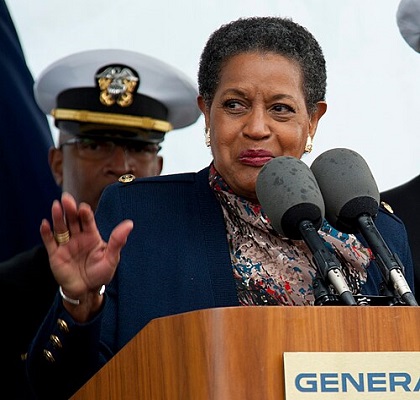
Myrlie Evers-Williams


March 17 …
Myrlie Evers-Williams is a pivotal figure in the American Civil Rights Movement whose lifelong dedication to justice, equality, and remembrance helped transform personal tragedy into a powerful legacy of activism, leadership, and social reform.
Born Myrlie Louise Beasley on March 17, 1933 in Vicksburg, MS, Evers-Williams was raised in a family that prioritized education, faith, and community responsibility. After earning a degree in education from Alcorn A&M College, she relocated to Los Angeles to teach and pursue graduate studies. Her upbringing instilled in her a belief in the transformative power of education and civic involvement — principles that would inform her impactful contributions in the following decades.
In 1956, she married Medgar Evers, a prominent NAACP field secretary in Mississippi. Their partnership was built on mutual intellectual engagement and shared struggle, with Medgar’s leadership in organizing voter registration, economic boycotts, and civil rights protests profoundly influencing her own activism.
The assassination of her husband in 1963 marked a pivotal moment in Evers-Williams’s life and the Civil Rights Movement. Rather than retreating from public engagement, she emerged as a powerful voice in the quest for justice for Medgar Evers and the broader civil rights struggle.
As an organizer, educator, and public advocate, Evers-Williams dedicated her life to advancing civil rights, honoring her husband’s legacy, and expanding the movement to encompass voting rights, women’s leadership, and community empowerment. She galvanized activists, collaborated with legal advocates to demand accountability, and sustained the momentum of local and national movements striving for legislative and cultural transformation.
Evers-Williams collaborated with renowned civil rights figures such as Martin Luther King Jr., Daisy Bates, and Roy Wilkins, exchanging strategies for nonviolent protest, voter education, and community organizing. Her role increasingly intertwined grassroots activism with policy advocacy, and she gained respect for her clear purpose and moral leadership. And her efforts have left a lasting mark on American society and culture, showcasing the strength of resilience and principled engagement in the face of challenges.
In the years following the height of the civil rights era, Evers-Williams broadened her focus to encompass institutional leadership and a national platform. She served on various boards and commissions, taught courses on civil rights and community leadership, and participated in national discussions on racial justice.
In 1995, she was appointed the national chair of the NAACP, becoming the first woman to occupy that position and guiding the organization through a revitalizing phase of activism and structural change. An accomplished author, Evers-Williams used her writing to explore personal experiences, collective memory, and the ongoing fight for equality, underscoring that civil rights is a continuous journey demanding vigilance, courage, and inclusive leadership.
Evers-Williams has received numerous accolades celebrating her resilience and contributions to civil rights and public life. She has been honored with prestigious awards from educational institutions, civic organizations, and cultural entities that recognize her leadership in justice and community service. Most notably, her role in advocating for the delayed conviction of her husband’s murderer exemplifies her unwavering pursuit of justice and the profound impact of her advocacy.
Beyond formal recognition, her legacy resonates in the lives of activists, educators, and community leaders she has mentored and inspired.
Today, the work of Myrlie Evers-Williams serves as a testament to how personal tragedy can ignite transformative action and illustrates the enduring power of collective struggle in the quest for a more just and equitable American society.
