
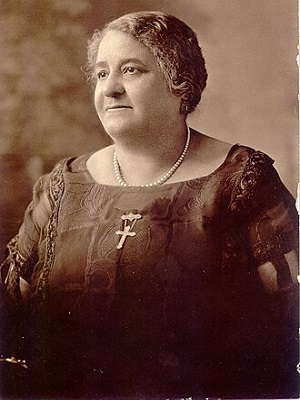
Maggie Lena Walker




July 15 …
Maggie Lena Walker was an American businesswoman, educator, and civic leader who became one of the most influential African American figures of the early 20th century.
Born on July 15, 186 in Richmond to Elizabeth Draper, a formerly enslaved woman, Walker grew up during the turbulent Reconstruction era. She attended the Richmond Colored Normal School, graduating in 1883, and taught briefly before marriage rules forced her to resign. Her early exposure to education and community activism shaped her lifelong commitment to Black economic advancement and self-help.
Walker’s most enduring legacy is her leadership of the Independent Order of St. Luke, a benevolent society founded in 1867 to provide burial insurance and mutual aid to African Americans excluded from mainstream institutions. She joined the order in 1881 and steadily advanced through its ranks.
In 1899, Walker became the Right Worthy Grand Secretary, the order’s chief executive, at a time when the organization was struggling financially. Through disciplined management, membership drives, and an emphasis on thrift and racial solidarity, she revitalized the order and expanded its reach across several states.
In 1903, Walker achieved a historic milestone by founding the St. Luke Penny Savings Bank in Richmond, becoming the first African American woman in the United States to charter a bank and serve as its president. The bank provided loans and financial services to Black customers who were largely excluded from white-owned banks. Under her leadership, the bank supported homeownership, entrepreneurship, and economic stability in the African American community. She also established the St. Luke Herald to promote the organization’s mission and encourage financial literacy.
Beyond her business accomplishments, Walker also engaged in civic and political life. She supported educational initiatives, worked with the National Association for the Advancement of Colored People, and advocated for women’s rights and racial uplift. Despite declining health later in life, she remained active in leadership roles until she died in Richmond on December 15, 1934.
Walker’s restored and furnished home in the historic Jackson Ward neighborhood of Richmond was designated a National Historic Landmark in 1975 by the National Park Service. In 1978, it was established as a National Historic Site to tell the story of her life and work.
The legacy of Maggie L. Walker endures as a pioneering example of Black female leadership in finance and in building fraternal organizations, demonstrating the power of collective economics and institutional self-determination in the face of systemic exclusion.
Sources:
- Marlowe, Gertrude Woodruff. A Right Worthy Grand Mission: Maggie Lena Walker and the Quest for Black Economic Empowerment. Washington, DC: Howard University Press, 2003.
- Dabney, Virginius, ed. “Walker, Maggie Lena.” In Dictionary of Virginia Biography. Richmond: Library of Virginia, 1998–. Accessed 2026.
- “Maggie Lena Walker.” Encyclopedia Britannica. Last modified July 11, 2023.
- “Maggie Lena Walker.” National Women’s History Museum. Accessed May 4, 2026.
- “Maggie L. Walker.” National Park Service, Maggie L. Walker National Historic Site. Last modified 2024.
- “Maggie L. Walker.” Virginia Museum of History & Culture. Accessed May 4, 2026.
About The Photo:
As a bank president, newspaper editor, and fraternal leader, Maggie Lena Walker inspired pride and progress. She devoted her life to civil rights advancement, economic empowerment, and educational opportunities for Jim Crow-era African Americans and women. Today, her home is a tribute to her enduring legacy in American society. (Photo of the Maggie L. Walker National Historic Site by the National Park Service.)
