
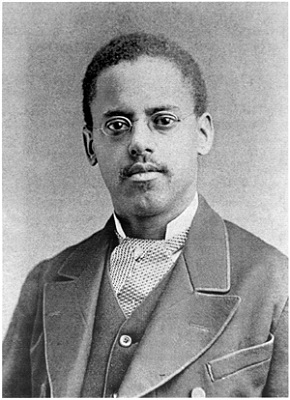
Lewis Latimer

September 4 …
Lewis Latimer emerged from humble beginnings to become one of the most influential African American inventors of the 19th century.
Born on September 4, 1848 in Chelsea, MA, Latimer was the son of formerly enslaved parents. He grew up in a nation still grappling with the contradictions of freedom and racial inequality. From an early age, he exhibited a natural curiosity and mechanical aptitude that would later define his career. Despite limited formal education, he taught himself technical drawing and engineering, eventually rising to become a key figure in the development of modern electrical technology.
Latimer’s professional journey began in the Union Navy during the Civil War, where he served as a teenager. After the war, he worked as an office boy at a patent law firm in Boston. Observing the firm’s draftsmen, Latimer taught himself mechanical drawing and quickly became proficient.
Latimer’s talent was recognized, and he was soon promoted to the role of draftsman. This skill became instrumental in his career, enabling him to contribute to several groundbreaking technological advances in the United States during the Industrial Age.
In 1876, Latimer was hired to draft the patent drawings for Alexander Graham Bell’s telephone. His detailed and precise work helped Bell submit his patent application just hours before a competing claim. This contribution placed Latimer at the heart of one of the most transformative inventions of the modern era.
Latimer’s most significant work came in the field of electric lighting, where he joined the U.S. Electric Lighting Company. This company competed directly with Thomas Edison’s organization in the race to electrify America.
Latimer’s greatest technological achievement came in 1881 when he developed a method for producing carbon filaments used in light bulbs. At the time, Edison’s light bulbs used paper filaments that burned out quickly. Latimer’s innovation significantly increased the durability and efficiency of light bulbs, making them more practical and affordable for widespread use. He later joined Edison’s company and became the only African American member of Edison’s elite research team, known as the “Edison Pioneers.”
Beyond his contributions to electric lighting, Latimer authored a book titled Incandescent Electric Lighting, which served as a comprehensive guide to the new technology. His ability to explain complex scientific ideas in accessible language helped promote public understanding and acceptance of electric light.
Latimer also held several other patents, including designs for an improved toilet system for railroad cars and a device for cooling and disinfecting indoor air, demonstrating the breadth of his inventive thinking.
Latimer’s achievements were not only technical, but also cultural. As an African American working in elite scientific circles during a time of severe racial discrimination, he shattered barriers and redefined what was possible for Black Americans in science and engineering. He became a role model for aspiring inventors and was active in mentoring young African American engineers and scientists. His career challenged the racial norms of his time and contributed to a broader reimagining of African American potential in American society.
Latimer died in 1928, but his legacy continues to illuminate the path for inventors and innovators across generations. His work helped lay the foundation for the electrical age, and his life stands as a powerful example of perseverance, talent, and quiet revolution.
The story of Lewis Latimer is an essential chapter in American history &mash; one that highlights the power of knowledge, the importance of inclusion in innovation, and the enduring impact of those who dare to envision a brighter future.